Showing posts with label mental health. Show all posts

Thursday, 17 December 2020

Why we shouldn't rush to get back to normal

Life has changed in 2020. That's stating the obvious, of course.

I enjoyed my life in 2019 and previous years a lot more than I've enjoyed 2020, and my heart is aching to get back to freely seeing friends and family like I used to. I'm sick of my own house. Now, with a vaccine being rolled out before Christmas in the UK, it finally seems like life might get back to normal again next year. I, like most people, can't wait for things to get back to the way they were.

But although I loved the old normal much more than I love the new normal, if we think about it rationally, we probably shouldn't rush so much to get back to the old normal. After all, the old normal provided the ideal breeding ground for covid-19, didn't it?

The Perfect Storm

What was it about the old normal that enabled covid-19 to conquer the world? Our exploitative relationship with nature allowed the virus to transmit to humans in the first place, and our relationships with each other allowed the virus to spread. Specifically:

Habitat destruction. It's pretty simple: when we destroy animals' habitats, they either move elsewhere or die. We know they're dying because of the mass extinction that's taking place, but animals are also moving further afield - into human-populated areas. When humans and wild animals live in close proximity, disease can spread from them to us more easily.

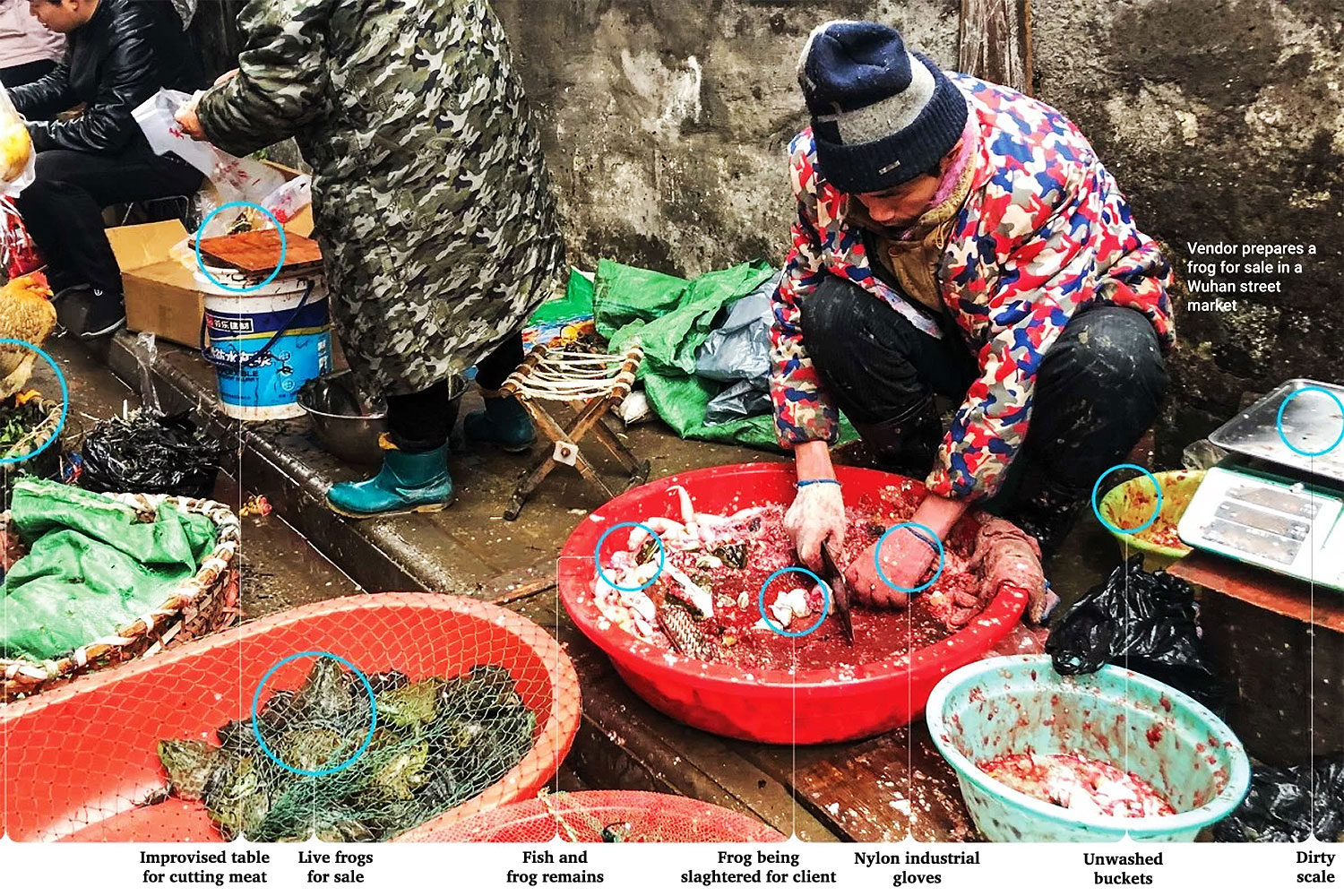
Live animal markets. I can barely begin to explain my disgust at the abhorrent live animal "wet" markets which take place throughout China and some other southeast Asian countries. Aside from the morally indefensible ways in which animals are treated in such places, such markets enable humans to mix with wild, exotic, domestic and farmed animals. This makes them perfect places for viruses to leap from one species to another.
Who would have thought that markets like this would lead to disease?
Image source: Bangkok Post

Densely populated cities. If people had lived in rural communities which kept themselves to themselves, the virus would have fizzled out very quickly. I imagine there are uncontacted Amazonian tribes who are totally unaffected by covid-19; for those of us who live in cities, it's a different story.

International travel. Without air travel, the virus that began in Wuhan would have taken a long time to reach our shores, or may not have reached us at all. But with international travel being what it is, people were freely flying in and out of Wuhan and around the world throughout January, and the virus was here in the UK within just a few days of the outbreak in Wuhan

Shared facilities. Humans live in large communities where we share transport, shops, places of worship, educational establishments, leisure facilities, and food outlets with one another. Shared facilities - especially those with limited cleaning and high footfall - are ideal places for viruses to spread.

Twenty-first century living is great in many, many ways... But humans' way of life has created the perfect storm: covid-19 has spread astonishingly quickly. To put it bluntly, human contact with animals enabled the virus to make the leap to our species, and our interconnected lifestyles in big cities enabled it to spread.

But covid-19 is an anomaly, right?

Well, no. You'd be forgiven for thinking that covid-19 is an anomaly: I myself have pointed out in a previous post that several other lesser pandemics (or almost-pandemics) have come and gone over the last 20 years. 

And apparently, scientists have long been "preparing" for a killer pandemic, ominously calling the hypothetical disease "Disease X". (Wowsers, if 2 million deaths and international omnishambles occur when the world is prepared, then I'd hate to see what might have happened if weren't prepared!) The scientists apparently speculated about Disease X a few years ago. I didn't know this until a few months ago. 

We are lucky that the fatality rate of covid is so low (around 1-2%); by contrast the mortality rate of Ebola and Bubonic Plague (the Black Death) is around 50%. And the worst part of it all is that scientists predict that there will be another, deadlier pandemic within the next decade. I hope they're wrong, but I fear they may be right. If the old normal was a perfect breeding ground for covid-19 --which evidently, it was -- then a return to the old normal will facilitate a new pandemic at some point in our future.

So what should we do?

Clearly, if we are to avoid future pandemics then something needs to change. But I - probably like everyone else - want to have my cake and eat it. I want to have MY old life back, but I want the rest of the world to change so as to prevent future pandemics. I imagine that everyone else feels the same. We all want our old lives back, whether our old lives consisted of going to football matches, university lectures, playing Bridge at a friend's house, or gutting live frogs in a wet market.

I am willing to make concessions such as social distancing or wearing masks in shops, but to have to avoid my family and friends for the rest of my life for fear they might die if I breathe near them,.. well, I don't want to live the rest of my life like that. 

I think the UK is over the hump of the pandemic now (though I'm sure many more deaths will occur - possibly a few million across the world, and it may get worse before it gets better for the people in countries which are slow to vaccinate). 

Image source: Stat News

But what about future pandemics? Well, I never believed that covid-19 would be a pandemic until mid-March and the deaths were skyrocketing, but now I'm (sadly) a convert: I think there will be future pandemics. if it can happen once it can happen again. and next time might have a far higher death rate or it might pick off kids instead of the sick and elderly. There's just no way to know.

Will we learn from covid-19? We might wash our hands a little more frequently, and people may continue to wear masks voluntarily after covid has gone - the way Chinese people have long since worn masks for any and every occasion. And maybe we'll keep our distance from strangers a tiny bit more than we used to. But generally, in the long term, I think we'll be very quick to forget 2020 and keen to jump straight back into our old ways of life, while the next pandemic is quietly brewing away.

Sunday, 3 May 2020

Lives versus livelihoods

Picture the scene... you're standing on the edge of a precipice. There's been an accident, and someone is hanging off the edge, barely able to cling on. But they're not the only thing hanging off the edge of the cliff. Nearby, someone's job is also hanging off the edge, barely able to cling on. You can save either the person or the job, but probably not both. It is not guaranteed that you'll be able to save either, but you can give it a go, though it will involve a bit of inconvenience for you to attempt to save either of them. So, which do you choose to save - the person, or the job?

It's a no-brainer, right? If we can ignore for a moment the fact that a job isn't a physical thing that can hang off the edge of a cliff, saving the person's life is still intuitively morally correct.

In case you're unconvinced that lives outrank livelihoods, here's another example.

Picture the scene... a building is on fire. Trapped inside is a person, breathing in the smoke, coughing - they will probably die if no one does anything. Also inside the building is someone's savings, or perhaps their business itself. There probably isn't time to save both the person and the business/savings. You'll have to choose. Saving either of them will be inconvenient for you, but won't place you in mortal danger.

Other things being equal, we would all surely say that human life should be prioritised over money or business. 

And yet, the "lives versus livelihoods" dichotomy which people would be so sure about if we were on the edge of a cliff or beside a burning building is apparently a lot trickier when it comes to covid-19.

A lockdown involving the closure of businesses, shops, and leisure facilities is detrimental for livelihoods, but it saves lives by slowing the spread of the virus. Contrariwise, keeping such places open allows livelihoods to thrive (or at least, to just about stay afloat) at the expense of people's lives - they die because the virus spreads so much. When places such as pubs, restaurants, cinemas and leisure centres are open, money changes hands (+ve for livelihoods and the economy) and viruses change hosts (-ve for lives and the NHS).

The difference, it seems, is whose livelihoods are at stake. Unsurprisingly, those whose livelihoods are most at risk from lockdown (small business owners) are the most vocal in criticising lockdowns. In terms of the analogies above, when S is on the edge of the precipice, and S must choose between saving her own business / savings and saving the life of an elderly stranger, S seems more inclined to save her own livelihood. Also unsurprisingly, those who have most to gain from a lockdown (say, those with elderly parents, or relatives with immune disorders) are the ones most in favour of lockdown. If S is on the cliff and forced to choose between saving his own relative, or the money of a stranger, S saves his relative. 

It seems that agent-neutrality has already fallen off the cliff, and plummeted to its death.

But when we are dispassionate and neutral - when it's a stranger's livelihood versus a stranger's life - I think (I hope!) that most of us would choose to save a person's life. That should give us the inkling that humans generally value lives over livelihoods. And for what it's worth, I think that's the morally correct stance to take.

A few weeks ago, when each covid-19 death in the UK was a news story in its own right, the media always pointed out the age of the victim (they were generally over 60), and whether they had any pre-existing medical conditions (they generally did). It was almost as if these were mitigating factors we could console ourselves with. 
"A woman has become the first coronavirus fatality in the UK"
"Ah yes, but she was in her 70s and had underlying health conditions, so was probably going to die soon anyway."

The subtext is one that suggests that people's lives are worth less (or worthless) if they are a bit old or are in poor health. I think many would agree that we should save the lives of children over the lives of the elderly, but to save jobs and money over the lives of the elderly or vulnerable is something else entirely. People who oppose lockdowns because of the threat to livelihoods are doing so in desperation; nonetheless, they really should re-examine their moral compass.

Another factor is proximity. Singer wrote a great paper (Famine, Affluence and Morality) about how we (wrongly) care more about seeing someone in danger right in front of us, than we do about knowing someone far away from us is in danger. Here's a quote from Singer:

"It makes no moral difference whether the person I can help is a neighbor's child ten yards away from me or a Bengali whose name I shall never know, ten thousand miles away. [...] From the moral point of view, the prevention of the starvation of millions of people outside our society must be considered at least as pressing as the upholding of property norms within our society." (Pp231, 237)

Singer's argument is a little different from mine as he argues that saving a life close to us matters just as much as saving a life far away from us, whereas I'm arguing for the more moderate claim that saving a life (anywhere) matters more than saving money. But if I'm right, the fact that the anti-lockdowners and the lockdown-rulebreakers don't see the deaths they have caused is at least partially what causes them to prioritise their own money over someone else's life.

If a person really was on the edge of a cliff with someone about to die if he does nothing, that situation is a lot more potent than knowing that somebody somewhere will die if he does nothing. I've written previously about people encouraging suicide online - something we don't generally do when a person is right in front of us. The same phenomenon is at play with covid 19 as it is with online suicides, and children starving in faraway countries. Business owners who defy lockdown and people who throw parties in defiance of lockdown are both "benefitting" ftom the fact that they don't see the damage they cause. They don't see the link between their actions today and people's deaths next month. They don't see people keeling over and dying in front of them, or a pile of dead bodies in their front garden. Because of that, it's very easy for them to think only of themselves and their lifestyle or livelihood.

The solution
There are no good solutions to the covid-19 pandemic: there are only bad outcomes. Thousands of people in the UK have died from the virus, and more will certainly die. Livelihoods have been and will be lost during the lockdown. So there are no 'good' solutions. All we can do is try to choose the least worst option.

Just as we would do if we stood on the edge of a cliff, or at the door to a burning building, we should save people's lives first and foremost, then worry about finances later. Money can be lost, and it can be regained. Someone who loses their business can set up another one, or take another job elsewhere. The person who loses their money will get second chances to make money and have a good life. The people who die get no second chance. So in the lockdown versus livelihoods contest, I believe lives should be prioritised.

Friday, 6 March 2020

Aphantasia - I never realised I think differently from everyone else

Imagine a beach. Can you see the sand and the waves? I can't.

This week I discovered that I have something known as aphantasia. This is the inability to see things in my imagination - my mind's eye is blind! Of course, I've always known that I didn't really see anything when I imagined it (why would I see it? it's only imaginary after all!), I just never knew that other people really did see what they imagined. I still find it hard to believe that other people see what they imagine.

I was writing something about robot faces as part of my PhD research and I wanted to find out the name for seeing faces in inanimate objects, like doorknobs and car headlights (it's called pareidolia, by the way) and I came upon a page about aphantasia, describing how some people don't see anything when they imagine it. This was not a revelation; it seemed to be pointing out the blatantly obvious. It's like saying that people don't look as beautiful as they wished they looked, or that people aren't as rich as they want to be. Well duh, imaginary things and reality are obviously different. Turns out, it's not so obvious after all, as most people can see what they imagine. Weird.

Baggy McBagface. Image source: The Conversation

It's really strange that I never realised that my thinking was any different to anyone else's, and yet according to several studies, this "condition" of mine affects just 2-3% of people! So I'm in a tiny minority.

So aphantasia is a minority thing; most people have normal phantasia (they see what they imagine), and another minority at the other extreme have hyperphantasia (an exceptionally vivid imagination). I was certainly surprised to discover these differences in how we imagine. I've read Descartes, Locke, Hume, Kant, and other philosophers who wrote about ideas and imagination, and discussed these with others at length. Yet never did I realise that others were imagining differently from me.

Which of these categories do you fall into? To find out, you can take a VVIQ test here. I scored the very lowest score on every single question: no matter how hard I try, I don't 'see' anything when I imagine it. Visualising a beach is as impossible as visualising a colour that doesn't exist; imagining a house is as impossible as imagining what the thirty-second flavour of the alphabet sounds like.

How do I know what I'm imagining?

You might wonder how I know when I'm imagining something. How do I recall what things look like? That's not particularly easy to explain, but I'll try. 

I know when I am imagining something because I'm aware of the thought in my mind. I have thoughts, such as "I'm hungry", and "I must remember to go to the post office" and "I remember putting my purse on the shelf yesterday" and "horses are yay tall" and "5 x 6 is 30". None of these thoughts have any imagery for me, but I now understand that some of them may have imagery for other people. But the imagery really doesn't seem necessary to the thought. I know that 5 x 6 is 30 without having to visualise a rectangle of five squares in six rows: I just remember the fact. It's the same with where I put my purse, or what my mother looks like. I can rattle off a 'shopping list' of features of my mother, just as I can rattle off an actual shopping list. I don't need to see a picture of my mother in my mind to know that she has short hair.

It's both fascinating and unfathomable to discover that other people's imagination really is different from mine. I had no idea. Our minds are private, and I suppose that's why people like me manage to go so long without realising our minds are different to anyone else's. I could quite easily have never found out.

Wittgenstein gave an example that helps illustrate this. He asks us to imagine that everyone has a little box, and inside their box is something which everyone calls a beetle. No one can look in anyone else's box, but each can look in his own box. Everyone says they have a beetle in their box, but I have no way of knowing whether the contents of my box (my 'beetle') are the same as the contents of yours, or indeed if some people have empty boxes. The mind is the same; I cannot leave my own mind and look inside someone else's to check if it's the same as mine.

Probably not what Wittgenstein had in mind, but it's hard to know for sure.

What is life like for me, without any visual imagination?

Well, it seems totally normal to me not to see things I imagine, but that's not helping you to understand what it's like, so I'll try to clarify. But knowing which features of me are features of aphantasia and which are just parts of my personality is tricky. There's no way for me to separate the two, but I'll do my best. But know this: life with aphantasia feels totally normal. I see things that are real, and I don't see things that are imaginary.

Inside my imagination
When I close my eyes and imagine something, all I see is some sort of brownish blotches such as this. I suppose it's the insides of my eyelids that I'm seeing, because when my hands are over my eyes, what I see is darker, and when I'm in bright sunlight, what I see is lighter. But literally whatever I'm imagining or thinking about, this is what I see (if my eyes are closed; if my eyes are open I see what's in front of me).

Some people with aphantasia say they don't have visual dreams. I do. Dreams seem just as real to me as reality does (until I wake up of course). I can recall some dreams and they seem quite vivid. Of course, when I recall them I don't see any images though.

Many people with aphantasia report having a bad memory, particularly for visual things. I would say I have a pretty good memory actually: I can learn the names of a new year group of up to 60 students in a week. I have memorised all the national flags of the world (if I see the flag, I can identify the country; I find it much harder to hear a country's name and describe the flag though), and I obviously have a mind good enough to manage a PhD. I fare very well on all aspects of IQ-type tests, including things that seem to rely on imagination, such as spatial reasoning. I can memorise lists of things, and I can recall things I've heard more easily than many people can. For example, a few years ago I did some conservation work in the Amazon rainforest, and I learned over 70 bird calls. I didn't find it easy, but I did manage it where many others failed.

But my mind isn't perfect; I'll forget appointments if I don't write them down, and I forget how to do things if I don't practice. But I think that's fairly normal. 

I don't really enjoy reading fiction. Especially fiction which is description-heavy such as Lord of the Rings; it's excruciating to have to trawl through lengthy descriptions of a landscape. The fiction that I do occasionally read is more action-based, or I could happily read a play - where there's almost no description at all. I prefer non-fiction, as it sticks to the facts. Although I can read as quickly as anyone else, my comprehension is slower than I'd like. When I used to read fiction, it wasn't uncommon for me to reach the end of the book, but struggle to recall the plot. I have to make notes on academic papers or I will very quickly forget what I've read. That's a bit of a pain, but I've always managed: I am a prolific writer and happy enough to make notes on things I read.

What must life be like for people who do have a visual imagination?

It seems very strange -- and disturbing -- that some people see what they imagine. If you are seeing things that aren't real, that aren't there, then that to me sounds like an hallucination, if not the sign of a serious mental disorder. And suppose a person is imagining their dog is sitting next to them. When they see the dog, how would they know if it's the real dog or the imaginary dog?! It must be a bit like being in a hall of mirrors. Not to mention terrifying. I have sometimes imagined scary or upsetting events - if I actually saw these things happen in front of me because I'd imagined them, I'd be a dribbling wreck, seemingly surrounded by skeletons and snakes and other monstrosities - all imaginary, of course. 

But maybe people don't imagine scary things - perhaps they only imagine nice things. I must admit, it would be nice if I could call the faces of my deceased loved ones to mind, but I can't. I cannot see them any more, and when I imagine (think of) them, I see nothing at all. Dealing with grief must be a whole lot easier when you can just 'see' your loved ones and talk to them simply by imagining it. 

And holidays.... there'd be no need to go and see the Pyramids at Giza, the Grand Canyon, and the Hanging Gardens of Babylon, given that you can just 'see' them for free by imagining them. I'd save a fortune on holidays if I could just see anything I wanted to by an act of will! I'd travel the universe too.

Imaginary pancakes... or are they real? 
I've read that it's not just the sense of sight, but that most people can hear, smell and taste the things they imagine too (there doesn't seem to be the same phenomenon happening for touch though). I don't experience any of these things when I imagine them.

If others really can hear, taste, smell and feel what they imagine, then dieting must be a breeze! You could eat a tiny salad but just imagine that it was a burger and chips, or eat the same dull porridge oats for breakfast every day, but just imagine it was a breakfast fit for a king! I can only assume that it's not as simple as that, but I just can't get my head around the idea of really, actually experiencing the things you imagine.

Just a figure of speech

I'm still sceptical that others really do see (hear etc) what they imagine. Surely, no one can actually see something that's imaginary? You're having me on! It's a collective joke, for sure. Or perhaps - just like with the Emperor's new clothes - no one wants to admit that they can't see something which others claim to see. Most people don't want to feel "abnormal", to have a deficiency in place of an ability which others have.... if indeed others really do have it. So if some people say they can visualise something, others may agree even though they can't in fact visualise it. 

Or like the old me, people may think "visualising" something is just a figure of speech. I speak that way too: I say things like "ooh, I can just imagine myself lying there on the beach under the sun"... well yes, I am thinking about it, and as far as I am concerned, thinking about something and imagining it are the very same things. I always believed that people were speaking figuratively when they said they could 'see' or 'visualise' things. I knew I didn't mean it literally, so assumed they were the same.

Life goes on

It's a curious thing to go one's life (over 40 years now!) having an unusual condition and all the while, thinking it was normal. Anecdotal evidence on forums seems to suggest that people can go almost their entire lives without realising there is anything unusual about their thought processes. It's fascinating to think that a condition such as this, which has presumably been prevalent for quite some time, has hitherto gone unnoticed (or unnamed at least) until the 20th century. It does make you wonder what other mysteries people might be hiding within their minds, all of us trapped in our own little worlds, trying to interact as best we can. 

But in truth, lacking the ability to actually see what is only imaginary does not bother me at all, any more than it bothers me that I can't sense electromagnetic signals the way a shark can, or sniff out a missing person the way a dog can. These are not senses I need nor really want. I am perfectly happy to live with my mind the way it is, and be safe in the knowledge that everything I see, hear, smell, taste, and touch is real. 

Probably.


Thursday, 24 October 2019

Scholar's guilt

Today is the first day in years that I've had an entire day to myself. My son is away for the day and night with Beavers, and I had an entire day to do with as I pleased.

Obviously, I have day times when he's at school and I am at home, but this was an entire 24 hour period.

It was weird.

So what did I do with my time? Well, I did a few necessary tasks like laundry, then I decided no, I should make the most of having the day of freedom.

So, I got myself a glass of wine (it was 4pm; I never drink before my son's bedtime to this was an uncharacteristic indulgence), set up the hammock hanging between two trees in my garden, and lay back and read a book.

Sounds leisurely enough, right?

The book was an academic text which I think will be pretty crucial for my PhD (John Danaher's Robot Sex). I was highlighting and making notes too.

The incessant studying even on a day of 'freedom' is of course caused by a phenomenon that many students, professors and academics are familiar with: scholar's guilt.

Whenever I'm not writing/researching (and not parenting) I have a voice in my head which says "you should be working on your PhD". It's like a micro-managing pedant lives on my shoulder, forever checking up on what I'm doing.

That's not to say I'm always working - of course I'm not! In fact I found the time today to scroll through Pinterest while lying in the hammock - then accidentally dropping my mobile phone onto the floor and smashing the screen on it 😭 (and I was only a couple of gulps into the wine, in case you're wondering!) But I digress.

The salient point is that while I was scrolling through Pinterest- and later, Googling how much it costs to repair the screen on my phone (it costs about 75% of what I paid for for the phone 😭) - I had scholar's guilt all the while.

I suppose it's just something that people either learn to live with, or they somehow overcome it. I don't get the guilt when I'm with my son, as there is no conceivable way I could do any substantive work while he's awake... but whenever he's asleep or away from me, I feel it. The nagging feeling that I ought to be working. Even when I'm sleeping over at my mum's house, or on the few occasions when I wake up before my son, the scholar's guilt is there, telling me to get PhD-ing.

Then again, perhaps a little scholar's guilt is a good thing, or else I may spend my non-childcaring time just lazing around in a hammock and drinking wine all day long. Then I'd never complete the PhD - and it'd cost me a bloomin' fortune in smashed phones too!

Friday, 27 September 2019

Is it OK to ask whether a woman has kids?


People have made a claim in recent years that no one should ask a woman whether she has children, whether she's planning on having (more) children, and why (not). The claim is that having children is a personal issue which can be very upsetting for some women to talk about, whether they are being asked by strangers or close family members. Below I consider whether these claims are justified: is it really so bad to ask these questions?

Do you have kids?

For many years I couldn't imagine myself as a mother – nor indeed was I sure I wanted to become one. In my 20s, particularly after I'd been in a relationship for a few years, people would ask about whether I was planning on getting married, and whether I planned on having children. Although I found the questions a little tiresome, I gave my answer (‘no’ or ‘I don’t know’) and it was usually met with acceptance. Luckily for me I was surrounded by people who didn't pressure me or try to guilt me into following the conventional path of marriage and children. If I had been subjected to frequent questioning and pressure from my family, friends or even strangers, this could have been unbearable. So I can wholly understand why it is so annoying for people who are frequently on the receiving end of pressure to produce offspring.

During my childless years, strangers also occasionally asked me whether I had kids, and I didn't really mind this, it's a reasonable question to ask of a woman in her 20s or beyond. I wasn’t berated for being unmarried and childless, but I used to have to field the questions about why I didn’t have children, and those were more frustrating, as though I had to explain and justify why I hadn’t procreated yet. After all, parenting is (in many societies, at least) a lifestyle choice and not a moral requirement. So asking someone whether they are a mother seems permissible, but continuing to question them about why they are or aren’t a mother becomes something else. (Analogously, asking someone if they’re a vegetarian is reasonable, but asking “why are you vegetarian?” is infuriating. No one should have to justify their food intake any more than their procreation status, but that’s another post for another day). What we can avoid, and indeed should avoid, are the ‘why’ questions about someone is childless. When someone says they don't have any children, the whys and wherefores of their situation are no one’s business but their own. Asking whether they have children is engaging in small talk; asking why they don't have children is prying and pressuring.

Making connections 

People make connections with others by talking. It's how friendships build up, and conversations often make the day more pleasant and less boring. Generally, small talk focuses on elements of people's lives or the news – look at the weather, what's your job, where do you live, and suchlike. Asking someone whether they have children is in this category, it seems. As a mother, I know that talking about children to someone else who has children is a great way to find common ground and build a rapport. How else could I find out that we have this in common if I weren’t to ask them if they have kids? If someone asks another person whether they have kids and the answer is yes, this will probably be followed up with questions such as how many, boys or girls, how old are they, and so on. This is how people converse and make friends, and this should not be prevented.

There are of course some questions that are out of bounds for strangers to ask one another, for example about their sex lives, or their toileting habits. These are highly personal questions which would rightly be met with shock and condemnation if they were to be asked in most situations, but whether or not a person has children is not in this league. “Do you have any kids?” is much more similar to “What’s your job?” or “Do you have any pets?” than it is to “How often do you have sex?”

But childlessness can be a touchy subject. And there are many reasons why a woman might not have children. (The same is true of a man, but I don't think childless men are questioned and judged in quite the same way as a childless woman is: after all, a woman's sole function on earth is to raise children, right? (*sarcasm)) 

So, why doesn't S have children? Perhaps she doesn't have enough money to support a child; perhaps she is single and has no partner with whom to conceive a baby; perhaps she has chosen to focus on her career rather than motherhood; perhaps she is not attracted to men; perhaps she's planning on having children, but just not right now; or perhaps she simply does not like children and doesn't want to have any! These (and many others) are perfectly legitimate reasons for someone not to have a child. And it may well be the case that if these are the reasons someone doesn't have children they may feel comfortable saying these to family members or strangers. 

But there may also be people who would really like to have a child but for some reason they don't. For example, perhaps she or her partner may have a health condition which makes it difficult or impossible to conceive; perhaps she has been pregnant but suffered miscarriage or stillbirth; perhaps she had one or more children who have now died; perhaps she has gone through a divorce and not been given custody of her children; or perhaps her children have been taken into care because she was an inadequate parent. These are not likely to be topics of conversation which someone is happy to explain to strangers, and it is understandable why someone in one of these situations would hate being asked whether they have kids, and I have every sympathy for these people.

"I just get so upset when I think about the rain"

However, anything can be a touchy subject: any question which someone asks to another person in the process of small talk could potentially be upsetting. For example, suppose I strike up a conversation with a woman about the weather, complaining that it's raining again - this may seem to be an innocuous conversation starter, but she may find the conversation upsetting for some reason. For example, perhaps her partner is a meteorologist and she is just discovered he's been cheating; perhaps her daughter slipped when it was raining and fell under a bus and was killed; perhaps she is on the way to her sister's wedding and the rain is going to ruin the day; perhaps when it rains she is reminded of the time she was raped in the pouring rain; or perhaps she was talking about the rain when her mother had a stroke and has been institutionalised ever since. Any of these could be the case, and this could mean that my chatting about the rain upsets the person I'm talking to. However, the mere possibility that someone may be upset by talking about the rain should not preclude us from talking about the rain to anyone.

If mere chit chat about the rain could upset people, then it is easy to see how asking someone about their job, or whereabouts they live, or whether they have any pets, could be even more distressing topics of conversation, after all, they may have lost their job, or maybe they're about to have their home repossessed, or maybe their dog just mauled a child to death - who knows? The same can be said for asking them whether they have children. It might upset them, but given that most people are not upset or offended by being asked whether they have kids, it is reasonable to ask the question. I cannot allow the fact that someone might be upset by talking about children prevent me from asking them whether or not they have children. (As suggested above, interrogating them about why they don't have children is something quite different indeed. The why questions are just prying, and imply judgement too.)

The verdict

This hasn't been my most eloquent or philosophically flawless argument, but I think it is intuitively correct: we need to make a judgement about the chance that someone would be offended, versus the opportunity of building a rapport. "How often do you have anal sex?" is quite likely to offend, and minimally likely to build a rapport, whereas asking about the weather is very unlikely to offend, but doesn't build much of a rapport either. "Do you have kids?" is a reasonable way to build a rapport with someone, and although it carries the possibility of upsetting a minority of people, this should not preclude us from asking it - so long as we don't interrogate others about why they do or do not have kids.

Friday, 14 June 2019

"They mustn't have had many good submissions" - impostor syndrome and negative assumptions

A couple of months go, I sent off an abstract to a CFP for a conference and this week I got an email saying I'd been accepted/invited to present my work there. "Hooray!" I thought - which was almost immediately followed by the thought "Maybe they didn't have many good submissions." I astonished even myself with my instantaneous self-doubt! "Maybe they're desperate for speakers?" I wondered, and "Maybe their reviewing procedures are biased?" I asked myself as I recalled the double-blind review procedure.


I can, through an act of will - and in defiance of my inner critic - insist to myself "No, my work was selected because it was good, not because they are desperate or careless with their selections", but it does sometimes feel forced and disingenuous to say that to myself. 

Of course, I recognise that my self-doubts are impostor syndrome, plain and simple (but if I recognise I have it, then I realise I'm good, and if I know I'm good then I don't have impostor syndrome!) 

Anecdotally, impostor syndrome seems commonplace among high achieving people. As kids, they see coming second as failure; getting 98% in a test just shows you weren't perfect; and no matter how well they do, still the feeling remains inside them that it's simply not good enough. Does this come from the school system? (I've seen the 'Two stars and a wish' strategy all over the place - ie each piece of work receives two positive comments and one suggestion for how it could be improved further.) I think self-doubt is perhaps reinforced by a school system which of course wants to push children to make progress. If my teachers hadn't reminded me that I needed to put capital letters after a full stop, I probably wouldn't do it now. But it can't be just the school who are to blame, as there are many kids who (outwardly, at least) aren't self-critical. But so often these aren't the kids who are getting 95% and just have a positive self-image; they are the kids who are getting 45% but just don't care that they're doing badly. There really does seem to be a correlation between high achievers and the feeling that one isn't (yet) good enough. 

Some self-doubt and feelings of inadequacy is probably what causes the high achieving - or at least helps it along. I work hard, achieve well, feel like it's still not good enough, and so work harder and achieve more. It's a good recipe for high achievement!

John Stuart Mill (I ❤️ Mill!) wrote that it's better to be Socrates dissatisfied than a fool satisfied. In many ways, it seems to be true - the esteemed but sometimes dissatisfying life of high achievers does seem to be of a higher quality than the satisfaction a 'fool' gets from, say, reality TV and beer. I'd hope that achievement and happiness are not mutually exclusive, but if they are, then for my son I'd choose happiness over achievement every time. 

But what of my own impostor syndrome? Well, I suppose I really ought to heed the advice I've given to various kids about taking pride in your achievements and accepting praise and compliments with good grace. So I'll say this (even though it feels boastful and forced): if I've been chosen to speak at a conference, it's because I'm good enough to do so. I'm awesome!!

Sunday, 19 May 2019

Why people encourage suicide online

Many philosophical issues - and many interactions with others - are not matters of life and death. But some are.

Please note that this post contains discussion of suicide, and why some people endorse suicide. If you think you will find this upsetting then you may choose not to read on.

One of this week's headlines involves a 16 year old girl who took her own life after she posted a poll on Instagram asking her followers or others to decide whether or not she should die; 69% of respondents voted that she should die... A few hours later she took her own life.

This is an utterly tragic story. Any loss of life, particularly one so young, is really sad. It's made so much more tragic when the cause of the death is suicide. And worse again that she did so upon the suggestion, encouragement and endorsement of others. Suicide is, in my opinion at least, the most overwhelmingly sad cause of death for family and friends of the deceased. Whenever someone dies it provides some small amount of comfort to know that "he had a good life" "he fought right till the very end" or "he made the most of his life" but these cannot be said when suicide is the cause of death, because the deceased was not just unhappy, but so immeasurably unhappy that they think there is nothing worth living for any more. My son is only young but I know there is no greater fear for a parent. It's the second leading cause of death in children and teens (behind car accidents) in the Western world. It can happen to anyone and is totally preventable and never something which should be encouraged or done flippantly as a result of a poll on Instagram. Suicide is not a hashtag; it ends the life of a person and ruins the lives of family and friends - particularly parents - of the deceased, and I hope if anyone close to me ever feels so desperate, that they turn to me rather than social media.

But this is not a post solely about the tragedy of suicide - the tragedy of suicide is fairly obvious. This post concerns the girl who took her life after the Instagram poll and asks the question: why did 69% of people vote that she should kill herself?

In some sense, people's motives are an empirical matter; their motive is what it is, and that's the end of it. But it's my blog so I can do it if I want, even if it's not "real philosophy", so I'll hypothesise and comment upon some possible reasons why someone might vote yes in a suicide poll.

So here are some possible reasons I think someone might vote yes to a suicide poll on Instagram. I think they're fairly exhaustive but maybe there are other motives too.
- they're using reverse psychology to save her life
- they think suicide is the ideal way for her to end her pain and suffering
- they think suicide is awesome
- they're evil, sadistic bastards
- they don't think she'll really do it
- the distant and impersonal nature of social media makes people say things they wouldn't normally say

Let's consider each of these:

They're using reverse psychology to save her life

Sometimes I can't decide between A and B, so I flip a coin to help me decide. Sometimes when it turns up A, I feel disappointed, and that tells me that what I really wanted was B, so I do B. Similarly, sometimes when you can't decide something, having another person suggest a course of action can actually persuade you to do the opposite; it makes you realise what you actually want. Perhaps some people were attempting this sort of 'bluff' to make the girl confront the reality of suicide so as to realise that she did in fact want to live, in the same way that sometimes telling a child to give up X-ing makes them try harder to X. It's reverse psychology at its simplest. So yes it's possible that people were trying to do this, but I don't think there are many people who would want someone to live and therefore tell them to commit suicide; it's too risky a bluff. But it could combine with another reason below such as they don't think she'll do it.

They think suicide is the ideal way for her to end her pain and suffering 

It's possible that some people voted 'yes' to the girl's suicide out of some sort of misguided sympathy. They saw someone in mental anguish and felt sorry for her; they wanted her pain to end. In the same way that someone might see a dog in extreme pain and conclude that it's better for the dog to be euthanised so its pain ends. This sort of mentality relies on the mistaken assumption that staying alive will be bad, and is almost certainly the faulty reasoning which suicidal people utilise. Even if something terrible has happened in your life, suicide is never the answer. There will be some bad parts of life but life is still precious and suicide only ruins the lives of others. Except in cases of painful terminal and degenerative illnesses, life is better than death. Most people know this, and enjoy most of life. I'm not trying to be flippant, as I've felt suicidal before, but life got better and now I have an awesome life.

So did people vote yes out of misguided sympathy, or giving the girl what she wants? This is possible, but highly implausible. If someone really cared about the girl, they'd urge her to seek help and go on living.

They think suicide is awesome

I suppose there are some people who think suicide is a good thing. Perhaps because it rids the world of sad people, and it's just basically cool and decadent, that it's done by celebrities, and a way of gaining notoriety. This is a ludicrous viewpoint. Anyone who thinks suicide is good is serously mistaken; it's the worst thing in the world. I don't think that any living person genuinely thinks suicide is cool and a great thing to do, but if they do they need to turn to family and friends and mental health services to seek help (some links are at the bottom of this post).

But do I believe anyone voted yes because they have this viewpoint? It's a distinct possibility. Social media can become an echo chamber and maybe her followers think that suicide is a good thing, as she did.

They're evil, sadistic bastards 

This is the go-to reason which most of us assume when we hear that people voted yes to someone contemplating suicide. There have been polls (I don't have any references though) where people have said that if murder was legal or they knew they wouldn't face punishment then they would probably do it. I guess many people who have that feeling are thinking it with a particular person in mind. They don't want to kill just anyone, they want to kill their ex or someone who bullied them, for example. But yeah there are undoubtedly people who just want the experience of killing. Maybe they've killed insects and small animals and enjoyed it and they fancy killing someone but they don't want to go to prison... but then up pops an Instagram poll and they get the chance to cause someone's death just for fun, and so they click yes. All the fun of a murder, without the prison time (however it's worth noting that encouraging or helping someone to take their own life is a crime in the UK.)

I think the "guiltless murder" mentality probably (sadly) accounts for some of the yes votes.

They don't think she'll really do it

Many people who see a poll about suicide probably doubt that the poster will really follow through, but that alone wouldn't explain them clicking yes. It would have to be teamed with another belief, like "I don't think she'll do it, so I'll call her bluff" or "I don't think she'll do it, so it doesn't matter if I click yes". Even so, either of these motives are taking a very risky and very flippant attitude towards life and death. Because it shows that the person voring hasn't really grasped the gravity of the situation. Yes the girl who posted the poll might be bluffing, but are we so sure that she's bluffing that we're willing to bet her life on it? If yes then we fall into the "evil sadistic bastard" group above, and if no then we would not click yes, just in case she means it. I doubt that the butcher would stab my mum, but if he's stood there with his knife and asks if I would like her to be stabbed, then I'm not going to call his bluff. We wouldn't risk someone else's life on the basis of a hunch unless we kind of wanted the death to occur, or simply didn't care one way or the other, in which case, we're evil sadistic bastards.


The distant social media effect

This is the notion that the distant and impersonal nature of social media makes people say things they wouldn't normally say, and although I think this is probably true, it still does not fully explain people's actions.

The Trolley Problem is a famous philosophical thought experiment involving a runaway train, where a person must make a choice: do nothing and five people will die, or pull a lever and you kill one person (saving five). Most people say they'd pull the lever. In a second scenario, a person must make a choice: do nothing and five people will die, or physically push another person onto the train tracks, and you kill one person (saving five). Here, most people say they wouldn't push the person -- even though the consequences and indeed the motives are identical to the scenario with the lever.

Why?

Probably some sort of proximity effect. Physical contact with the victim brings it much closer to home, and that makes us more mindful of our actions. Knowing that some people died in a faraway land is easier to cope with than knowing that some people died in a nearby area, even when we don't know the victims. News organisations are well aware of this, and the agenda is always local-centric. Translate this into social media and suicide and we might understand that the suicide of someone in front of you in the flesh is more shocking than the suicide of someone far away whom you never knew, and don't see them dying, you don't see their family grieving, and you don't see the aftermath of their death. Analogously, being mean to someone online is 'easier' than being mean to someone in the flesh.

But being mean is still being mean, and encouraging suicide is still encouraging suicide; would a person of good moral standing be mean or encourage suicide simply because they're online? I don't think they would. It seems to me that the anonymity of the Internet coupled with the ease of making comments without dealing with the consequences merely makes people say things they kind of want to say anyway, but they stop themselves because of social convention. Social media is a bit like a "truth serum" inasmuch as people who are nasty at heart show themselves to be nasty when online. Nice people don't encourage others to commit suicide simply because they've gone online. For example, before social media, when chat rooms and online forums were a thing, I frequently corrected people's spelling, grammar, and apostrophe usage, I pointed out flaws in their arguments, and I told them when they'd got their facts wrong. The Internet didn't make me become such a pedant; I am a pedant, and the Internet gave me the means to say the things I always felt like saying, but was (often) too inhibited. In other words, it showed me up for what I really am. Analogously, the people who endorse suicide online almost certainly have a nasty streak in them, and social media has merely brought it out for all to see. The distancing effect of the Internet does not on its own explain people who voted yes to the suicide of a girl. The idea that people say things online which they wouldn't normally say is only a partial explanation, and must be coupled with some underlying personality trait or belief such as the ones mentioned above (eg being an evil bastard, or thinking she won't do it) in order to be a full explanation.

Conclusion 

We're a highly evolved species, but for all our advancement we still have some very primitive drives within us. The drive to be successful, and to out-compete others is right up there with the drive to procreate as one of our most primitive urges. One way to out-compete others is by making yourself look better; another is by making others look worse. That explains bullying (in a very clinical and woefully inadequate way). When people think they can improve their social standing - eg by being nasty to someone else - they may take the opportunity to do so. And when people think there is no possible way for them to ever improve their social standing, they may perceive that there is just no point in anything any more. People are the best thing in the world, and the worst thing in the world. But there is never a good reason to encourage another person to take their own life, and there is never a time when suicide is the only or best choice. There is always, always something that can be done, and someone who can help.

Here are some useful links if you are feeling unhappy, depressed or suicidal, or you know someone who is:
The Samaritans website or phone 116123
Child line website or phone 0800 1111
Mind website
And of course, if you feel you can't keep yourself safe right now, call your GP for an emergency appointment, or 999.