Saturday, 23 January 2021
Collective restrictions
Thursday, 17 December 2020
Why we shouldn't rush to get back to normal
I enjoyed my life in 2019 and previous years a lot more than I've enjoyed 2020, and my heart is aching to get back to freely seeing friends and family like I used to. I'm sick of my own house. Now, with a vaccine being rolled out before Christmas in the UK, it finally seems like life might get back to normal again next year. I, like most people, can't wait for things to get back to the way they were.
But although I loved the old normal much more than I love the new normal, if we think about it rationally, we probably shouldn't rush so much to get back to the old normal. After all, the old normal provided the ideal breeding ground for covid-19, didn't it?
The Perfect Storm
What was it about the old normal that enabled covid-19 to conquer the world? Our exploitative relationship with nature allowed the virus to transmit to humans in the first place, and our relationships with each other allowed the virus to spread. Specifically:
Habitat destruction. It's pretty simple: when we destroy animals' habitats, they either move elsewhere or die. We know they're dying because of the mass extinction that's taking place, but animals are also moving further afield - into human-populated areas. When humans and wild animals live in close proximity, disease can spread from them to us more easily.
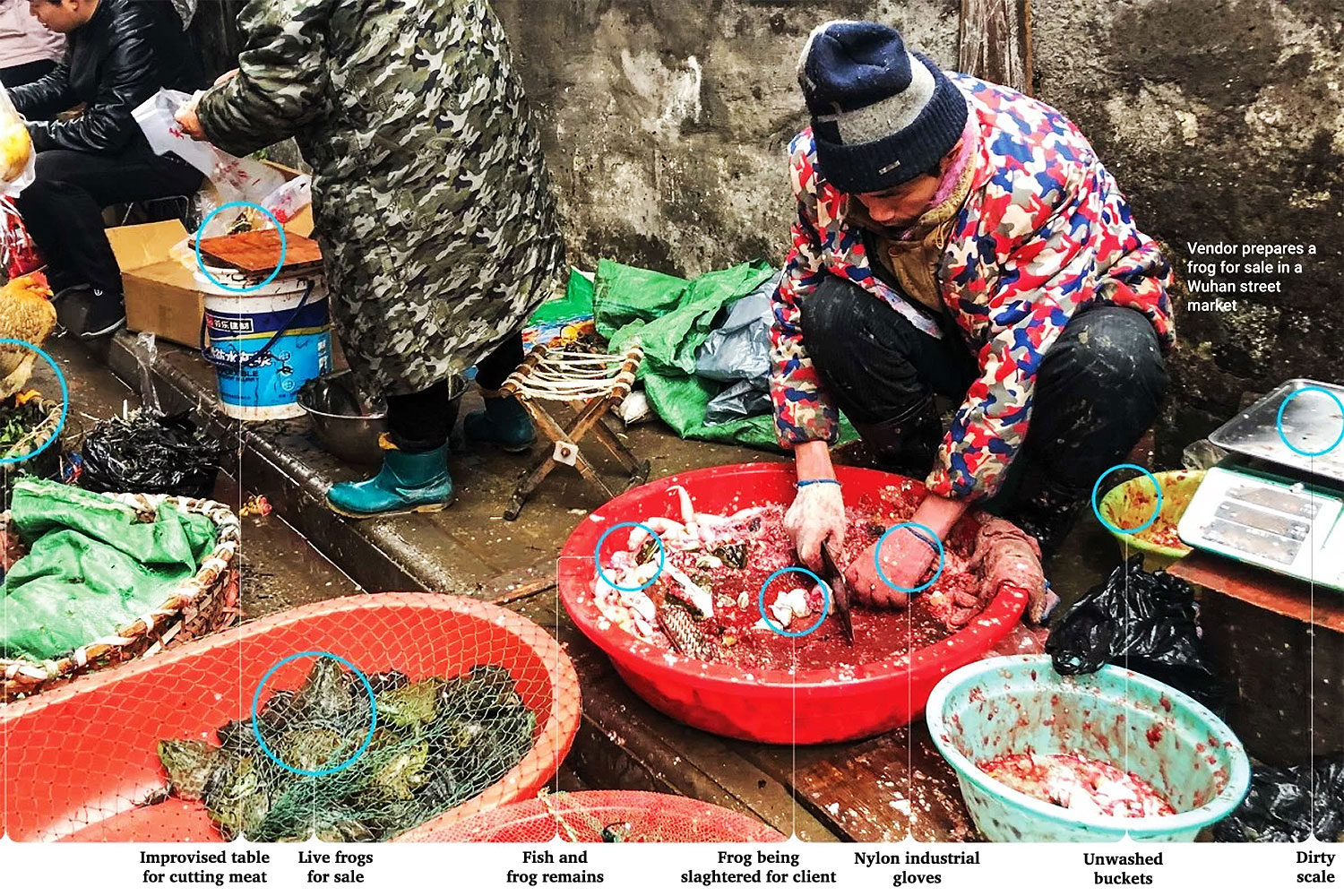
Live animal markets. I can barely begin to explain my disgust at the abhorrent live animal "wet" markets which take place throughout China and some other southeast Asian countries. Aside from the morally indefensible ways in which animals are treated in such places, such markets enable humans to mix with wild, exotic, domestic and farmed animals. This makes them perfect places for viruses to leap from one species to another.![]() |
| Who would have thought that markets like this would lead to disease? Image source: Bangkok Post |
Densely populated cities. If people had lived in rural communities which kept themselves to themselves, the virus would have fizzled out very quickly. I imagine there are uncontacted Amazonian tribes who are totally unaffected by covid-19; for those of us who live in cities, it's a different story.
International travel. Without air travel, the virus that began in Wuhan would have taken a long time to reach our shores, or may not have reached us at all. But with international travel being what it is, people were freely flying in and out of Wuhan and around the world throughout January, and the virus was here in the UK within just a few days of the outbreak in Wuhan.
Shared facilities. Humans live in large communities where we share transport, shops, places of worship, educational establishments, leisure facilities, and food outlets with one another. Shared facilities - especially those with limited cleaning and high footfall - are ideal places for viruses to spread.
Twenty-first century living is great in many, many ways... But humans' way of life has created the perfect storm: covid-19 has spread astonishingly quickly. To put it bluntly, human contact with animals enabled the virus to make the leap to our species, and our interconnected lifestyles in big cities enabled it to spread.
But covid-19 is an anomaly, right?
Well, no. You'd be forgiven for thinking that covid-19 is an anomaly: I myself have pointed out in a previous post that several other lesser pandemics (or almost-pandemics) have come and gone over the last 20 years.
And apparently, scientists have long been "preparing" for a killer pandemic, ominously calling the hypothetical disease "Disease X". (Wowsers, if 2 million deaths and international omnishambles occur when the world is prepared, then I'd hate to see what might have happened if weren't prepared!) The scientists apparently speculated about Disease X a few years ago. I didn't know this until a few months ago.
We are lucky that the fatality rate of covid is so low (around 1-2%); by contrast the mortality rate of Ebola and Bubonic Plague (the Black Death) is around 50%. And the worst part of it all is that scientists predict that there will be another, deadlier pandemic within the next decade. I hope they're wrong, but I fear they may be right. If the old normal was a perfect breeding ground for covid-19 --which evidently, it was -- then a return to the old normal will facilitate a new pandemic at some point in our future.
So what should we do?
Clearly, if we are to avoid future pandemics then something needs to change. But I - probably like everyone else - want to have my cake and eat it. I want to have MY old life back, but I want the rest of the world to change so as to prevent future pandemics. I imagine that everyone else feels the same. We all want our old lives back, whether our old lives consisted of going to football matches, university lectures, playing Bridge at a friend's house, or gutting live frogs in a wet market.
I am willing to make concessions such as social distancing or wearing masks in shops, but to have to avoid my family and friends for the rest of my life for fear they might die if I breathe near them,.. well, I don't want to live the rest of my life like that.
I think the UK is over the hump of the pandemic now (though I'm sure many more deaths will occur - possibly a few million across the world, and it may get worse before it gets better for the people in countries which are slow to vaccinate).
![]() |
| Image source: Stat News |
But what about future pandemics? Well, I never believed that covid-19 would be a pandemic until mid-March and the deaths were skyrocketing, but now I'm (sadly) a convert: I think there will be future pandemics. if it can happen once it can happen again. and next time might have a far higher death rate or it might pick off kids instead of the sick and elderly. There's just no way to know.
Will we learn from covid-19? We might wash our hands a little more frequently, and people may continue to wear masks voluntarily after covid has gone - the way Chinese people have long since worn masks for any and every occasion. And maybe we'll keep our distance from strangers a tiny bit more than we used to. But generally, in the long term, I think we'll be very quick to forget 2020 and keen to jump straight back into our old ways of life, while the next pandemic is quietly brewing away.
Thursday, 3 December 2020
Are drag queens as offensive as blackface?
Over the past year or so, some people in the media have apologised for performing in blackface. In this post I'm going to argue that drag queens are offensive in the same way - although perhaps not to the same degree - as blackface is. Consequently, drag queens should be axed from the screens and stages just as Minstrels have been.
Blackface
Blackface, for the uninitiated, is when an actor or performer applies dark make up - typically to the face, but maybe the hands or elsewhere too - in order to perform as a person from an ethnic group with a darker skintone than their own. For example, if a white person was playing the role of a black person, and applied make up to facilitate that role.
| George Mitchell, creator of the Black and White Minstrel Show, was awarded an OBE in 1975 for his work on the show |
![]() |
| Ant and Dec 'disguised' as Jamaican women Patty and Bernice, in Saturday Night Takeaway. |
In short, blackface is objectionable because it presents caricatured, demeaning stereotypes of black people;* this contributes towards the dehumanisation of black people which was a defining feature of slavery. The donning of black make up -- as if blackness is a costume one can wear for fun -- is a form of morally objectionable cultural appropriation. Given the history of oppression (not to mention present-day discrimination) which black people have suffered at the hands of white people, it's no wonder people object to blackface.
* Sometimes blackface involves an performer impersonating someone of Southeast Asian origin. The prevailing opinion seems to be that this is still offensive, though it lacks the slavery-related offence dimension.
Drag queens
If it's offensive to dress yourself up as an oppressed (or historically oppressed) group to which you do not belong, then blackface is not the only form of offensive appropriation which exists. Although there are (morally questionable) examples of able-bodied actors playing disabled characters, they generally do not present ridiculous caricatures of disabled people.
However, the same cannot be said of drag queens.
Drag queens, in my humble opinion, are horrific caricatures of what society (or perhaps just men) judge to be the defining features of women. Huge, coiffured hairstyles, ridiculous volumes of make up, false eyelashes, enormous breasts and/or bottoms, revealing dresses, trashy jewellery.... there is literally nothing fun or pleasant about what a drag queen represents. They represent the very worst expectations of women, donned by men for the sake of trite entertainment - typically in the form of singing show tunes or reality TV.- They perpetuate dangerous and offensive stereotypes. Women are not just big hairstyles, big boobs, trowel-fuls of make up, and showy clothes. But this is the image that drag queens portray when they "dress as women". This stereotype of women as nothing more than a sexualised, glamorous appearance is offensive - after all, drag queens are not impersonating the intellects of female scientists, the bravery of female firefighters, or the compassion of female nurses. The only thing they portray is the vile oversexualised appearance of the female caricature.
- They involve a powerful group dressing up as a less powerful group. They say that when it comes to comedy, you should 'punch up', not 'punch down'. This means that it is less offensive to make fun of those in power than it is to make fun of oppressed (or historically oppressed) groups. Sexual inequality has been rife throughout history, and still persists today in many areas of our lives. Just as it is offensive for white (privileged) people to portray caricatures of black people, the same is true of (privileged) men portraying gross caricatures of women.
- They use appropriation as entertainment. With The Black and White Minstrel Show, cultural appropriation was central to the entertainment value of the act: the fact they were white men made up as black men was (apparently) entertaining in itself. White men dancing, or black men dancing, just wouldn't have had the same sort of appeal. Similarly, a woman (dressed normally) or a man (dressed normally) singing the show tunes of which drag queens are so fond - well, it just wouldn't be the same. I suspect that most if not all drag queens are men who have tried to make it as (normal male) singers, failed, and have turned to drag queening as an alternative route to success. Their absurd make up and outfits make them inexplicably more appealing to audiences, just as wearing blackface suddenly (absurdly) catapulted the Minstrels to success.
- They pick out caricatured features of the target group. The Minstrels had the white eyes and the white or ruby red lips in stark contrast to the dark skin (make up). The drag queens have the enormous breasts, excessive make up, absurd hairstyles, and revealing dresses. Both pick out nonessential features of the target group, and do so in an unsympathetic way. Watching the show does not help us to feel more sympathetic towards the oppressed group, nor see them as equals; instead, it just encourages us to laugh at them. Drag queens and Minstrels add to the oppression because they dehumanise the target group, making them appear as 'other' and presenting a one-dimensional view of the target group.
But people love drag queens!
Disclaimer
Tuesday, 3 November 2020
The US election in Venn diagrams
Today is election day in the US. At times, it seems to dominate the news media more so than the UK election did! I thought it would be fun to do a post about the US election, told through Venn diagrams.
What happened in Texas
Postal votes and fraud
How I'll feel when watching the election results
Why we'll watch it
Public opinion
Disclaimer:
A final note on democracy
Saturday, 24 October 2020
Essential shopping and the sorites problem
This week, as part of its "firebreak" lockdown, Wales announced that supermarkets will no longer be allowed to sell non-essential products, and it got me thinking about what "essential" products really are.
Below I'll argue that no products at all -- even food -- are essential if "essential" is to be understood as necessary for the preservation of life. Secondly, I'll suggest that even though many products are not truly necessary, it is reasonable for them to continue to be sold to us in 2020.
The firebreak
First, a bit of background. Wales, like the rest of the UK and indeed much of the world, is suffering rising numbers of deaths from covid-19. First Minister Mark Drakeford announced a couple of weeks ago that Wales would a so-called "firebreak" lockdown. More commonly referred to as a "circuit breaker" lockdown in England, a firebreak is a short (2-4 weeks) but thorough national lockdown aimed at cutting the spread of the virus in order to:
A) save lives
B) decrease the strain on health services
C) prevent a longer or more extensive lockdown being needed further down the line (a sort of "stitch in time saves nine" approach)
These are noble goals. The idea is that making people stay at home and refrain from mixing with one another should stem the spread of the virus. Under normal (or even "the new normal") circumstances, people often leave the house to buy non-essential products, so if non-essential items are not on sale, then that's a lot fewer people out spreading their germs around. It makes sense to me. But what products are actually "essential"?
Food
To know what products are essential, we need to know what "essential" means. Does it mean essential to having a nice, fun, plentiful life? Or does it mean people would literally start dying without said product? Perhaps it means something in between.
Setting the bar really low
If we define "essential" as "essential to having a nice, fun, plentiful life", then just about every product seems essential. This includes consumer electronics, all clothing, furniture and soft furnishings, toys and games, DIY products, entertainment items, books and stationery, as well as food and drink. Basically any item which is on sale might appeal to someone as a product which can give them a slightly better life, so is essential, and therefore can be on sale during the firebreak lockdown.
| "I just picked up a few essentials." Image source: Unsplash |
Setting the "essential" bar this low would mean that all retail outlets would remain open, selling everything they always did. I don't think that's what the First Minister had in mind.
Setting the bar really high
Perhaps the most intuitive definition of "essential" is "people will die without it". Essential does, after all, mean necessary; required; needed. Essential can mean essential to life. But it seems to me that just about all foodstuffs are non-essential.
Will I die if I don't eat my favourite brand of sausage? Nope. Will I die if I don't eat any fruit? Nope. Will I die if I don't eat any X (where X is any individual food or drink item)? Nope. Anyone who has watched the TV show Freaky Eaters will know that people can survive on remarkably limited and seemingly unhealthy diets for years or even decades.
Food is essential, but no individual food is essential. This presents us with a philosophical conundrum. Does this mean the shops should sell all foods, or no food. No one can reasonably argue that supermarkets simply must sell (e.g.) shitake mushrooms, thyme, canned salmon, mint ice cream, and digestive biscuits. We can live without these things. People might see milk, bread, eggs, and fresh fruit and veg as essential, but they are not. We would not die without these products. (The only product which I can see is essential in its own right would be baby formula for unweaned babies who aren't breast fed.)
This presents us with a sort of sorites problem:
- If the supermarkets all stopped selling one product, we could easily survive.
- If the supermarkets all stopped selling two products, we could easily survive.
- If the supermarkets all stopped selling n products, we could easily survive.
- ...
- Conclusion: If the supermarkets all stopped selling all products, we could easily survive.
![]() |
| Image source: Unsplash |
Alcohol
Don't even get me started on why the UK government and Welsh Assembly believe that alcohol is a necessary foodstuff. Off licences were one of the few "essential" businesses permitted to stay open during the first UK lockdown back in March. I know Brits are known around the world for drinking 15 pints in one session on a Friday night (and the same again on Saturday night, and maybe a few cheeky pints on Sunday too, plus a few cans after work during the week), but for the government to maintain that alcohol is essential is absurd.
I love a good bottle of red wine, but seriously, nobody needs alcohol. We might like it, love it, or even feel we need it, but we don't. In fact, a firebreak from alcohol might do more for the health of the nation than a firebreak from covid! The sheer horror of having a fortnight of sobriety is clearly too much to handle. Food is essential: booze is not.
Other products
Even if we accept that food is necessary, just about all other products in our lives are non-essential. Health-type products such as toothpaste, soap, sanitary towels, toilet paper, and laundry detergent might seem pretty important, but are they essential? Would we die without these products? Of course not! Plenty of people around the world manage without these things for their entire lives. It wouldn't be pleasant (for Brits) to have to survive without toilet paper, but bums can be cleaned with water and cloths, as they are elsewhere in the world.
| The Great Toilet Paper Shortage of March 2020 Image source: Unsplash |
Sanitary towels, too, are not a matter of life and death. Women across the world are forced to live in conditions such that they must use whatever they can during their periods. Cloths, toilet paper, menstrual cups -- all of these are alternatives to sanitary towels and tampons. Few women would want to go without sanitary products, but we could do it if necessary. Edit: It seems that some supermarkets have told shoppers that they can't buy period products! It's hard to know what to make of that. I know I'm saying they're not essential to life and limb, but they're more essential than alcohol, cakes, and many other products which remain on sale in Wales.
Concluding remarks
| Image source: Unsplash |
I realise that as with so many things during the pandemic (and probably the rest of the time too) the government are damned if they do, and damned if they don't. Could we survive without almost all products in the supermarket? Of course we could: shops are only a recent development in the history of mankind, and people around the world survive every day without tampons, bikes, alcohol and newspapers. But should we be expected to survive without these products in 2020? Probably not. It's quite reasonable for the Welsh people to demand that winter coats, tampons and disinfectant should be on sale even during the firebreak lockdown.
Edit: several of the news stories above seem to have prompted the supermarkets / the Welsh Assembly into conceding that period products, winter clothing, cleaning products and stationery should remain on sale in supermarkets during the firebreak.
Thursday, 13 August 2020
Will people of the future tear down our statues?
![]() |
| Black Lives Matter protesters tear down statue of slave owner Edward Colston |
Imagine, if you will, a public figure of present day (ish) who is considered to be highly respected or a national treasure. Perhaps David Attenborough, Trevor McDonald, Michael Parkinson, Princess Diana, Bruce Forsyth, Captain Tom Moore, Claire Balding, or Jamie Oliver.
Let's go with Sir David Attenborough: I think he's fantastic and has done so much for conservation, and is well deserving of a plethora of awards. There is a nature reserve here in Nottingham named after him. There's a ship named after him (remember "Boaty McBoatface"?). There are even a few species named after him. I bet there are plenty of other things too - and deservedly so. I think he's a national treasure, but if you don't agree, just insert the name of another all-round good egg in instead of him. As far as I know there are no statues of him, but let's suppose that one is erected, and it is there to celebrate all the great things he's done, and what a great man he is.
Now, suppose it's 150 years from now, in 2171, or thereabouts. The Attenborough Nature Reserve is still there, the HMS Attenborough is a museum ship, his statue is still there, and plenty of other things named after him are still around.
Let us suppose also that laws and social attitudes have moved on, and some things which are commonplace, legal, and generally considered permissible in 2021 are uncommon, illegal, and seen as morally wrong - even abhorrent - in 2171. For example, suppose the age of consent is 24, it's illegal to eat animals, and it's seen as just plain wrong to fly in an aeroplane for tourism or entertainment. I know that David Attenborough eats meat and flies by plane to different places; I'm less sure about his sexual experience, but let's say he has, as most people have, had sex with someone under the age of 24 at some point in his life.
![]() |
| How will future people view us? Source: Unsplash |
David Attenborough, so respected and revered during his lifetime, and mourned upon his death, is a figure representing beliefs and actions which are 'of his time', and the people of 2171 have no place in their hearts for someone who treated animals and the environment so badly (by eating them and polluting it, in their eyes), and in his sexual attitudes towards minors.
The fact that Attenborough has done a great deal for the environment, and that his views on meat eating and the age of consent are well-aligned with his contemporaries is lost on the people of 2171. They simply say "Eating animals, polluting the environment by air travel, and sex with minors, is wrong today, and it was wrong back then. The fact that many others in society also had the same values as Attenborough does not make it right. The fact that these things were legal does not make it any less morally objectionable." More 'active' activists tear down his statue, and demand that anything named after David Attenborough be renamed after another person with more palatable, less archaic beliefs and actions.
This is an entirely plausible future history, and is remarkably similar to the stories we see today about statues made in the image of particular historical figures, and the buildings, streets, and other things named after such people. Is eating animals and flying in an aeroplane as morally abhorrent as slavery? I don't think it is. But I do not have my beliefs in a vacuum; they are inherently linked to the time period in which I live. If I'd have lived in a different time, I am sure my views would have been coloured by the commonplace those around me.
I don't know much about the men whose statues were torn down earlier this year. Maybe they really were monstrous villains who bought their way into the history books and did no good deeds whatsoever in their lives. Or perhaps, like all of us, they did some good deeds in the world, and others which have not stood the test of time, as the moral tides have rolled onwards. Perhaps - almost certainly - the people who we consider national treasures today will not be quite so treasured by future peoples. In all likelihood, our descendants will see us as immoral and uncivilised, the way we look upon our ancestors who supported slavery, and our descendants will be tearing the statues which we erect today.
We can shrug and say so be it: we in 2021 have a right to tear down the statues of slave owners, just as the people of 2171 have the right to tear down statues of anyone whose views or actions they see as morally wrong. But if we think that the people of 2171 would be misguided to tear down the statue of Sir David Attenborough and vandalise it, then we should probably view the protestors who tore down the Edward Colston statue in the same way.
![]() |
| Human evolution. Source: Pixabay |