Showing posts with label health. Show all posts

Monday, 14 June 2021

Are the covid vaccines really doing any good? (Spoiler: yes they are)

I recently saw it reported that out of all the UK people who have died (so far) from the Indian (delta) covid variant, a third were double-vaccinated. The article was from The Sun: it's not something I usually read (because it's trash), but I must admit that when I saw the headline pop up in my news feed thingy on my phone, I was both intrigued and horrified. I clicked it.

I have only had one dose of the vaccine so far, and I have been looking forward to my second jab (scheduled for July), believing that it'd be my ticket to immunity. And the more of us are immune, the more we can start seeing each other again. Hearing that a third of people who've died from the Indian variant in the UK was not what I wanted to hear. If the vaccine programme isn't offering much protection, then it's pretty pointless, I thought... for a few seconds, until I read the sensationalised story and gave it a little more thought.

The Sun is telling the truth, in this instance; this article in The Telegraph reports the very same statistics.

Image source: The Telegraph, 12 June 2021

Although it is sometimes useful to look at the proportions of something, as these pie charts do, it is not always sensible. Yes, a third of people who have died from the delta variant in the UK have been double-jabbed, but exactly how many people are we talking about here? The answer is twelve. Twelve double-jabbed people have died from the delta variant - that's out of 42 people in total who've died from it. This is not a large or worrying number. 

Why? Because no vaccine is 100% effective. 

Around 30 million people in the UK have received two doses of the vaccine. So, out of the 30 million people who have been double-jabbed, just 12 have died from it. It's a tragedy, of course it's a tragedy, but from a statistical point of view, it's insignificant. Twelve deaths out of 30 million is less than 0.5 people per million.

But shouldn't we be concerned that a third of the deaths were in double-jabbed people? That seems like quite a high percentage.

Well, no.

As more and more people get vaccinated, the number of double-jabbed people in the UK is increasing. Suppose we were to reach a point where every single adult had had both doses. This would mean that any deaths from covid - and statistically, we'd expect there to be a few - would be in a person who was double-jabbed. One hundred percent of deaths would be occurring in fully vaccinated people. Although that might sound alarming, it's worth remembering that many people will die from flu each year despite having had the flu vaccine. So long as the raw number of covid deaths is low, the percentage of how many of them had been vaccinated is immaterial.

Of course, we shan't reach a 100% vaccination rate, as some people can't have it, and some people refuse to have it for whatever reason. But the more people have the vaccine, the greater the proportion of all deaths could be among vaccinated people - because they're so populous. 

We still need to be vigilant. We still need to wear masks and keep our distance. And we still need to get vaccinated.

Why did I allow myself to be drawn in by the clickbait sensationalism of The Sun? I don't know. I'm just glad that a few moments' thought enabled me to see the statistics for what they are.


I want the pandemic to be over.

Monday, 8 February 2021

How should we share covid vaccines?

Vaccinations in the UK are going well. Source: Unsplash
Covid-19 has had a devastating impact across the world. But now, thanks to the wonders of science, there are several vaccines which are safe and effective. Given that it takes time to administer the vaccines, not everyone can receive it straight away, so some people will have to wait their turn.

What I want to consider is how it should be determined who receives the vaccine first. The virus seems most dangerous to old people and those with underlying conditions such as diabetes, so I'll take it as a given that within a country, those people should be prioritised. However, what I'm wondering is how it should be determined which countries are first to receive vaccines, and how many. I'll consider these possibilities, that the countries to receive/use the vaccines first of all should be...

  1. The countries that make the vaccines 
  2. The countries with the highest death tolls
  3. The countries with the highest death rates
  4. The countries with the oldest populations
  5. The countries best able to administer the vaccines quickly

The countries that make the vaccines 

If country X has put extensive time, effort and money into researching and developing a vaccine, perhaps it is fitting that the citizens of that country are first in line to receive that vaccine. This seems fair in the same way that if I work hard to obtain some commodity or money, I should be allowed to spend it to benefit my kids. I did the work, so I can reap the benefits. 

A problem with this is that the covid vaccination system then becomes a question of wealth, with the richest countries in the world, such as the USA, China, Japan, and much of western Europe being first in line to receive vaccines, with the poorest countries in the world in places such as Africa, Asia and Latin America, being left behind. 

In the UK, we hold our NHS dearly - even more so since covid - and believe that healthcare should be based not on wealth, but on need. This means that we should find it uncomfortable to endorse a system where the countries which sink the most money into developing vaccines are the ones to receive the vaccine first, just in virtue of having been rich enough to develop a vaccine.

The countries with the highest death tolls

If we think that healthcare should be distributed based on need, then death tolls seem a pretty good measure of need. In the USA nearly half a million people have died from covid-19; it might seem like they are most in need of the vaccine, and therefore the USA should be the ones to receive it first.

But allocating vaccines according to brute number of deaths is obviously going to favour countries with large populations. it is no surprise that of the ten countries with the largest populations, five of them are among the top ten countries with the highest death tolls (Mexico, Brazil, USA, Russia, and India). This would mean that countries with small populations would be way down the list of who gets the vaccine, even though they may be in dire need of it, and experiencing far more deaths per head of population than some of the heavily populated countries, such as India.

The countries with the highest death rates

Calculating deaths per head of population seems quite a reasonable way of determining which country is in the most dire need of the vaccine. After all, they are losing the greatest proportion of their population to covid, it seems only fair that they should be helped the most by receiving the vaccine. 

However, this might unfairly favour tiny countries and territories. For example, these statistics (as of 4 Feb 2021) show that Gibraltar and San Marino have the highest number of covid deaths per head of population; they have suffered 79 and 68 deaths respectively, but because of their tiny populations, they are top of the table in deaths per head of population.

Moreover, simply having a high total number of deaths per head of population doesn't mean that a country is in dire straits now. It's possible that a country has had a high death rate per head of population, but then got things under control and now they don't have any cases. I'm not sure whether any countries actually fit into this hypothetical category, but they could do. Normally, in philosophy, the fact that something hypothetically could exist is good enough to prove a point, but this is real-world applied ethics, so reality matters. There are certainly countries who have got things more under control than others though, and a country whose daily death rate is really on its way down is perhaps less in need than a country whose daily death toll is on its way up, even if its overall death rate is currently low, because covid hit them later.

The countries with the oldest populations

There are several covid vaccines
available. Source: Unsplash
Covid is most dangerous to older people, so perhaps the countries with the oldest populations should be prioritised. Sure, there will be some countries with an ageing population who haven't been really troubled by covid, but why should that matter? Simply because they haven't had a high death toll or death rate yet doesn't mean they won't have one. And since a vaccine is about preventing deaths rather than treating those who are already ill and dying, then it really shouldn't matter at all that we'd be sending vaccines to some countries who aren't suffering too badly as yet.

However, countries which currently have low rates of infection don't really seem to be in dire need of vaccines in the same way that those with high rates of infection are. Perhaps such countries are good at stemming the spread of infection by other means, such as lockdown and mask-wearing, or perhaps the virus has mutated into a less potent strain in their area, and they won't really need the vaccine after all. So perhaps giving vaccines to countries basted on their population age isn't the best idea after all.

The countries best able to administer the vaccines quickly

Vaccines are a valuable resource - both economically and health-wise. It would be a tragedy if vaccines were given to a country which squandered them. There are some countries which lack the infrastructure, refrigeration facilities, staff, or other necessities to administer the vaccines quickly and effectively. It would be a great shame if vaccines were given to such countries and they were wasted, when other countries could have used them to save lives. 

Conclusion 

I've considered several possibilities above, and none are unproblematic. I believe that out of all the options, some sort of combination of death rate per head of population, and brute number of deaths, coupled with some understanding of who is suffering the worst right now. This would put Belgium, Czechia, Italy, the UK and USA as some of the first countries to receive the vaccine in great numbers. This isn't really a perfect solution, but I think it's a reasonable solution. Once the most vulnerable people in these countries have been vaccinated, it would be fair to move on to other countries (but if/when I'm offered it, I'll be snatching their hand off!)

In practice, there seems to be a mixture of sharing methods taking place. I'm glad that the UK is doing very well with its vaccine rollout -- we have a very high death rate at the moment, and I'll feel much more at ease when that's under control. I just hope that the vaccine rollout can be swift and effective everywhere, and that the pandemic will soon be over.

And finally...

Look at this infographic I drew. It took me ages, and without any special software, so please look at it! Alas, I can only put it on here as a flattened image, so the links don't work. And I can't get it to be high resolution, or the right dimensions for the screen. But here it is anyway!


Saturday, 23 January 2021

Collective restrictions

"Right, Lee, if you don't stop this behaviour right now, then the whole class will lose out on playtime.... ok Lee that's it, everyone is missing playtime, all because of you." 

I know I certainly experienced this sort of event as a child, when I, a generally well-behaved student, had my freedoms restricted because some idiot in my class was misbehaving. I felt the injustice of it then, and I still hear of teachers doing it today. It's wrong. 

Yet that is exactly what is happening with lockdown restrictions. I am staying home for over 23 hours per day. I haven't seen my parents in the flesh since Christmas; I haven't seen my elder sister in 6 months, and I've not seen my younger sister in a year. The last time I met a friend indoors was a year ago. This is not because I don't want to see my family and friends: in non-pandemic times, I'd see someone at least once a week, and partake in sports 1-2 times a week. I'm not doing the things I want to so because (a) The government have said not to do these things (b) I don't want to spread the virus (c) I don't want to catch the virus. 

I have curtailed my normal activities to such an extent that I don't think I could curtail them much more at all. My parents have not left the house in nearly a year, except to go to the doctors, or to have outdoor exercise. they order food and other products online, and haven't seen friends in I don't know how long. 

And yet, I hear on the news that lockdown restrictions aren't being successful enough, and that our freedoms may be curtailed further. I feel pretty sure that the continued spread of covid is not because of my behaviour, and I am certain that its not because of my parents' behaviour. 

There are people meeting in groups for weddings; organised sport and kids' sports clubs are still going on. People have been partying in pubs and in the street until the most recent lockdown. When I've driven through towns, I've seen large queues outside take aways and restaurants. So many people are still going into work, to work in non-essential jobs, and the number of kids in school is apparently around half of what it is when schools are fully open, and anecdotally, plenty of those kids have one parent who is a key worker, and another who is working from home, so the kids should really be at home, like the rest of us who are having to home school and do our work at the same time.

A lockdown would work, if people would actually lock down, and stay at home. But many people are not doing that. And so the government, like a teacher who is rapidly losing her rag, punishes the entire class rather than punishing the offender. But the thing is that if people are not adhering to current restrictions, why should we have any reason to believe that they'd adhere to more stringent restrictions?

If Lee - the naughty boy in the class I mentioned - doesn't do what he's told when the teacher says sit quietly and listen for 5 minutes, then when the teacher says everyone must sit quietly and listen during all of play time, would he suddenly reform his behaviour? Doubtful. Instead, the rest of the class - who had already sat quietly and listened for five minutes - now have to sit and listen for 20 minutes. And they do this, while Lee is still throwing a wobbler because he doesn't want to sit and listen at all. Nothing is achieved by forcing people who are already following the rules to follow more stringent rules, simply because some idiots were not following the first set of rules.

What really needs to be done is to get people to actually follow the rules and stay home. Because of the virus has an incubation period of about 7 days, and when people catch it they're infectious for 2-3 weeks, then really, if everyone could ACTUALLY lock down and self isolate for 3-4 weeks - or even 5 or 6 weeks just to make sure, then there should be no one infectious after that time, and the virus would be fully eradicated. Yes, it would be a right pain to be imprisoned like that, but it'd rid us of covid-19, and plenty of other communicable diseases too. 

Instead, those of us who are already isolating for alnost all day every day are now being told we need to isolate more. All the while, other people are partying, getting take aways, and going to non-essential jobs.

With that approach, this virus will be with us for a long time yet to come.

EDIT: Perhaps I hadn't given enough thought to the restrictions, as I was thinking that only essential workers should go into work. The restrictions say you must stay at home, but can leave for essential reasons, such as work or medical care. I was thinking this meant that people can only leave home for essential work, not nonessential work. So if a person worked in a factory sewing t-shirt sleeves together, they should stay at home and not go into work (because t-shirt sewing is not essential; the country won't grind to a halt without t-shirts for a few months). But now I come to think about it, there must be vast numbers of people who are using public transport and working in places, doing nonessential work. In a stricter crackdown, those nonessential workers should be stopped from working. The definition of a "key worker" is also pretty broad. Working in B&M Bargains, for example, makes someone a key worker. 

Thursday, 17 December 2020

Why we shouldn't rush to get back to normal

Life has changed in 2020. That's stating the obvious, of course.

I enjoyed my life in 2019 and previous years a lot more than I've enjoyed 2020, and my heart is aching to get back to freely seeing friends and family like I used to. I'm sick of my own house. Now, with a vaccine being rolled out before Christmas in the UK, it finally seems like life might get back to normal again next year. I, like most people, can't wait for things to get back to the way they were.

But although I loved the old normal much more than I love the new normal, if we think about it rationally, we probably shouldn't rush so much to get back to the old normal. After all, the old normal provided the ideal breeding ground for covid-19, didn't it?

The Perfect Storm

What was it about the old normal that enabled covid-19 to conquer the world? Our exploitative relationship with nature allowed the virus to transmit to humans in the first place, and our relationships with each other allowed the virus to spread. Specifically:

Habitat destruction. It's pretty simple: when we destroy animals' habitats, they either move elsewhere or die. We know they're dying because of the mass extinction that's taking place, but animals are also moving further afield - into human-populated areas. When humans and wild animals live in close proximity, disease can spread from them to us more easily.

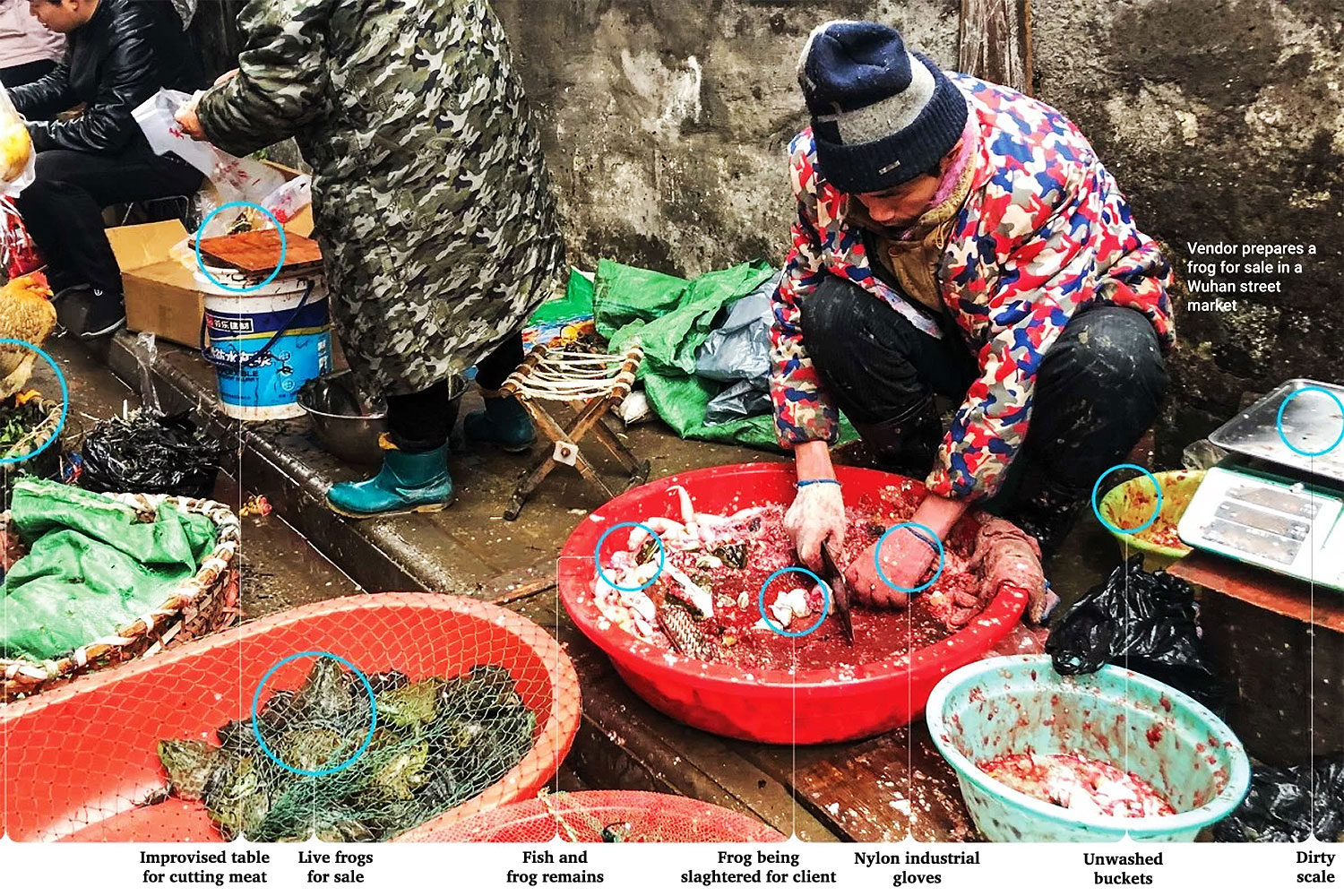
Live animal markets. I can barely begin to explain my disgust at the abhorrent live animal "wet" markets which take place throughout China and some other southeast Asian countries. Aside from the morally indefensible ways in which animals are treated in such places, such markets enable humans to mix with wild, exotic, domestic and farmed animals. This makes them perfect places for viruses to leap from one species to another.
Who would have thought that markets like this would lead to disease?
Image source: Bangkok Post

Densely populated cities. If people had lived in rural communities which kept themselves to themselves, the virus would have fizzled out very quickly. I imagine there are uncontacted Amazonian tribes who are totally unaffected by covid-19; for those of us who live in cities, it's a different story.

International travel. Without air travel, the virus that began in Wuhan would have taken a long time to reach our shores, or may not have reached us at all. But with international travel being what it is, people were freely flying in and out of Wuhan and around the world throughout January, and the virus was here in the UK within just a few days of the outbreak in Wuhan

Shared facilities. Humans live in large communities where we share transport, shops, places of worship, educational establishments, leisure facilities, and food outlets with one another. Shared facilities - especially those with limited cleaning and high footfall - are ideal places for viruses to spread.

Twenty-first century living is great in many, many ways... But humans' way of life has created the perfect storm: covid-19 has spread astonishingly quickly. To put it bluntly, human contact with animals enabled the virus to make the leap to our species, and our interconnected lifestyles in big cities enabled it to spread.

But covid-19 is an anomaly, right?

Well, no. You'd be forgiven for thinking that covid-19 is an anomaly: I myself have pointed out in a previous post that several other lesser pandemics (or almost-pandemics) have come and gone over the last 20 years. 

And apparently, scientists have long been "preparing" for a killer pandemic, ominously calling the hypothetical disease "Disease X". (Wowsers, if 2 million deaths and international omnishambles occur when the world is prepared, then I'd hate to see what might have happened if weren't prepared!) The scientists apparently speculated about Disease X a few years ago. I didn't know this until a few months ago. 

We are lucky that the fatality rate of covid is so low (around 1-2%); by contrast the mortality rate of Ebola and Bubonic Plague (the Black Death) is around 50%. And the worst part of it all is that scientists predict that there will be another, deadlier pandemic within the next decade. I hope they're wrong, but I fear they may be right. If the old normal was a perfect breeding ground for covid-19 --which evidently, it was -- then a return to the old normal will facilitate a new pandemic at some point in our future.

So what should we do?

Clearly, if we are to avoid future pandemics then something needs to change. But I - probably like everyone else - want to have my cake and eat it. I want to have MY old life back, but I want the rest of the world to change so as to prevent future pandemics. I imagine that everyone else feels the same. We all want our old lives back, whether our old lives consisted of going to football matches, university lectures, playing Bridge at a friend's house, or gutting live frogs in a wet market.

I am willing to make concessions such as social distancing or wearing masks in shops, but to have to avoid my family and friends for the rest of my life for fear they might die if I breathe near them,.. well, I don't want to live the rest of my life like that. 

I think the UK is over the hump of the pandemic now (though I'm sure many more deaths will occur - possibly a few million across the world, and it may get worse before it gets better for the people in countries which are slow to vaccinate). 

Image source: Stat News

But what about future pandemics? Well, I never believed that covid-19 would be a pandemic until mid-March and the deaths were skyrocketing, but now I'm (sadly) a convert: I think there will be future pandemics. if it can happen once it can happen again. and next time might have a far higher death rate or it might pick off kids instead of the sick and elderly. There's just no way to know.

Will we learn from covid-19? We might wash our hands a little more frequently, and people may continue to wear masks voluntarily after covid has gone - the way Chinese people have long since worn masks for any and every occasion. And maybe we'll keep our distance from strangers a tiny bit more than we used to. But generally, in the long term, I think we'll be very quick to forget 2020 and keen to jump straight back into our old ways of life, while the next pandemic is quietly brewing away.

Saturday, 24 October 2020

Essential shopping and the sorites problem

This week, as part of its "firebreak" lockdown, Wales announced that supermarkets will no longer be allowed to sell non-essential products, and it got me thinking about what "essential" products really are.

Below I'll argue that no products at all -- even food -- are essential if "essential" is to be understood as necessary for the preservation of life. Secondly, I'll suggest that even though many products are not truly necessary, it is reasonable for them to continue to be sold to us in 2020.

The firebreak

First, a bit of background. Wales, like the rest of the UK and indeed much of the world, is suffering rising numbers of deaths from covid-19. First Minister Mark Drakeford announced a couple of weeks ago that Wales would a so-called "firebreak" lockdown. More commonly referred to as a "circuit breaker" lockdown in England, a firebreak is a short (2-4 weeks) but thorough national lockdown aimed at cutting the spread of the virus in order to:

A) save lives

B) decrease the strain on health services 

C) prevent a longer or more extensive lockdown being needed further down the line (a sort of "stitch in time saves nine" approach)

These are noble goals. The idea is that making people stay at home and refrain from mixing with one another should stem the spread of the virus. Under normal (or even "the new normal") circumstances, people often leave the house to buy non-essential products, so if non-essential items are not on sale, then that's a lot fewer people out spreading their germs around. It makes sense to me. But what products are actually "essential"?

Food

To know what products are essential, we need to know what "essential" means. Does it mean essential to having a nice, fun, plentiful life? Or does it mean people would literally start dying without said product? Perhaps it means something in between.

Setting the bar really low

If we define "essential" as "essential to having a nice, fun, plentiful life", then just about every product seems essential. This includes consumer electronics, all clothing, furniture and soft furnishings, toys and games, DIY products, entertainment items, books and stationery, as well as food and drink. Basically any item which is on sale might appeal to someone as a product which can give them a slightly better life, so is essential, and therefore can be on sale during the firebreak lockdown. 

"I just picked up a few essentials." 
Image source: Unsplash

Setting the "essential" bar this low would mean that all retail outlets would remain open, selling everything they always did. I don't think that's what the First Minister had in mind. 


Setting the bar really high

Perhaps the most intuitive definition of "essential" is "people will die without it". Essential does, after all, mean necessary; required; needed. Essential can mean essential to life. But it seems to me that just about all foodstuffs are non-essential.

Will I die if I don't eat my favourite brand of sausage? Nope. Will I die if I don't eat any fruit? Nope. Will I die if I don't eat any X (where X is any individual food or drink item)? Nope. Anyone who has watched the TV show Freaky Eaters will know that people can survive on remarkably limited and seemingly unhealthy diets for years or even decades.

Food is essential, but no individual food is essential. This presents us with a philosophical conundrum. Does this mean the shops should sell all foods, or no food. No one can reasonably argue that supermarkets simply must sell (e.g.) shitake mushrooms, thyme, canned salmon, mint ice cream, and digestive biscuits. We can live without these things. People might see milk, bread, eggs, and fresh fruit and veg as essential, but they are not. We would not die without these products. (The only product which I can see is essential in its own right would be baby formula for unweaned babies who aren't breast fed.)

This presents us with a sort of sorites problem: 

  • If the supermarkets all stopped selling one product, we could easily survive.
  • If the supermarkets all stopped selling two products, we could easily survive.
  • If the supermarkets all stopped selling n products, we could easily survive.
  • ... 
  • Conclusion: If the supermarkets all stopped selling all products, we could easily survive.
The conclusion is obviously false, as with all sorites problems. The nature of a sorites problem is that small incremental changes to the number of items on sale (or grains of sand in a heap, hairs on a man's head) do not make any discernible difference to the conclusion that there is enough food (a heap of sand, the man is bald), but a big change does make a difference. All food isn't essential, but some food is.

There is no magic number at which we can say that the supermarkets are selling the "essential" number of foodstuffs. Moreover, even if we did discover the magic number of essential foodstuffs (say, 36 foods), that still wouldn't tell us which foodstuffs are the essential ones. Even if it were the case that, say, bread is essential, that still would not mean we needed 80 varieties of bread on sale in the supermarket.
Image source: Unsplash


But something tells me that Mark Drakeford wasn't concerned about a sorites problem when he proposed that supermarkets are only sell essential foods. 

In reality, outside of the philosophy classroom, we don't much concern ourselves with sorites problems. [Although I wrote this post about my son presenting me with a sorites problem when I asked him to eat all his peas.] We just tend to pick a point for the sake of pragmatics, and go with it (recent examples include the Rule of Six, and the limit of 15 guests at weddings).

In actuality, Wales' First Minister has deemed that all food products are essential, assuming they are for consumption off site (because cafes, pubs, and restaurants are closed). It's not true to say that they are truly essential, but deeming all food essential certainly helps to avoid unhelpful criticisms about why this food is more essential than that.


Alcohol

Don't even get me started on why the UK government and Welsh Assembly believe that alcohol is a necessary foodstuff. Off licences were one of the few "essential" businesses permitted to stay open during the first UK lockdown back in March. I know Brits are known around the world for drinking 15 pints in one session on a Friday night (and the same again on Saturday night, and maybe a few cheeky pints on Sunday too, plus a few cans after work during the week), but for the government to maintain that alcohol is essential is absurd.

I love a good bottle of red wine, but seriously, nobody needs alcohol. We might like it, love it, or even feel we need it, but we don't. In fact, a firebreak from alcohol might do more for the health of the nation than a firebreak from covid! The sheer horror of having a fortnight of sobriety is clearly too much to handle. Food is essential: booze is not.

Other products 

Even if we accept that food is necessary, just about all other products in our lives are non-essential. Health-type products such as toothpaste, soap, sanitary towels, toilet paper, and laundry detergent might seem pretty important, but are they essential? Would we die without these products? Of course not! Plenty of people around the world manage without these things for their entire lives. It wouldn't be pleasant (for Brits) to have to survive without toilet paper, but bums can be cleaned with water and cloths, as they are elsewhere in the world. 

The Great Toilet Paper Shortage of March 2020
Image source: Unsplash
During the 'Great Toilet Paper Shortage' of March 2020, I refused to panic buy, and was consequently was forced to face up to the prospect that I might have to do without loo roll as my supplies dwindled and I searched for toilet paper in 6 shops across 3 days. I cut up some old tea towels and bed sheets in preparation and desperation. Thankfully, I managed to secure 4 rolls of toilet paper at the eleventh hour from a petrol station, so the cloths were never used for that purpose - but they could have been. My point is that toilet paper is not truly essential; we could have survived without it.

Sanitary towels, too, are not a matter of life and death. Women across the world are forced to live in conditions such that they must use whatever they can during their periods. Cloths, toilet paper, menstrual cups -- all of these are alternatives to sanitary towels and tampons. Few women would want to go without sanitary products, but we could do it if necessary. Edit: It seems that some supermarkets have told shoppers that they can't buy period products! It's hard to know what to make of that. I know I'm saying they're not essential to life and limb, but they're more essential than alcohol, cakes, and many other products which remain on sale in Wales.


Concluding remarks

Image source: Unsplash
Under Wales' rules, the only shops which can stay open are food shops, convenience stores, newsagents, corner shops, bicycle shops, petrol stations, DIY/hardware stores, and off licences. This is a bizarre choice of shops if you ask me. It would seem that the First Minister believes that essential products are food, alcohol, petrol, bikes, and DIY products. Welsh shops have stopped selling stationery, cleaning products, and winter clothing. So I can buy wallpaper but I cannot buy a pen; I can buy 24 cans of Special Brew, but I cannot buy a coat. I can buy bathroom tiles, but not some disinfectant. 

I realise that as with so many things during the pandemic (and probably the rest of the time too) the government are damned if they do, and damned if they don't. Could we survive without almost all products in the supermarket? Of course we could: shops are only a recent development in the history of mankind, and people around the world survive every day without tampons, bikes, alcohol and newspapers. But should we be expected to survive without these products in 2020? Probably not. It's quite reasonable for the Welsh people to demand that winter coats, tampons and disinfectant should be on sale even during the firebreak lockdown.

Edit: several of the news stories above seem to have prompted the supermarkets / the Welsh Assembly into conceding that period products, winter clothing, cleaning products and stationery should remain on sale in supermarkets during the firebreak. 


Sunday, 3 May 2020

Lives versus livelihoods

Picture the scene... you're standing on the edge of a precipice. There's been an accident, and someone is hanging off the edge, barely able to cling on. But they're not the only thing hanging off the edge of the cliff. Nearby, someone's job is also hanging off the edge, barely able to cling on. You can save either the person or the job, but probably not both. It is not guaranteed that you'll be able to save either, but you can give it a go, though it will involve a bit of inconvenience for you to attempt to save either of them. So, which do you choose to save - the person, or the job?

It's a no-brainer, right? If we can ignore for a moment the fact that a job isn't a physical thing that can hang off the edge of a cliff, saving the person's life is still intuitively morally correct.

In case you're unconvinced that lives outrank livelihoods, here's another example.

Picture the scene... a building is on fire. Trapped inside is a person, breathing in the smoke, coughing - they will probably die if no one does anything. Also inside the building is someone's savings, or perhaps their business itself. There probably isn't time to save both the person and the business/savings. You'll have to choose. Saving either of them will be inconvenient for you, but won't place you in mortal danger.

Other things being equal, we would all surely say that human life should be prioritised over money or business. 

And yet, the "lives versus livelihoods" dichotomy which people would be so sure about if we were on the edge of a cliff or beside a burning building is apparently a lot trickier when it comes to covid-19.

A lockdown involving the closure of businesses, shops, and leisure facilities is detrimental for livelihoods, but it saves lives by slowing the spread of the virus. Contrariwise, keeping such places open allows livelihoods to thrive (or at least, to just about stay afloat) at the expense of people's lives - they die because the virus spreads so much. When places such as pubs, restaurants, cinemas and leisure centres are open, money changes hands (+ve for livelihoods and the economy) and viruses change hosts (-ve for lives and the NHS).

The difference, it seems, is whose livelihoods are at stake. Unsurprisingly, those whose livelihoods are most at risk from lockdown (small business owners) are the most vocal in criticising lockdowns. In terms of the analogies above, when S is on the edge of the precipice, and S must choose between saving her own business / savings and saving the life of an elderly stranger, S seems more inclined to save her own livelihood. Also unsurprisingly, those who have most to gain from a lockdown (say, those with elderly parents, or relatives with immune disorders) are the ones most in favour of lockdown. If S is on the cliff and forced to choose between saving his own relative, or the money of a stranger, S saves his relative. 

It seems that agent-neutrality has already fallen off the cliff, and plummeted to its death.

But when we are dispassionate and neutral - when it's a stranger's livelihood versus a stranger's life - I think (I hope!) that most of us would choose to save a person's life. That should give us the inkling that humans generally value lives over livelihoods. And for what it's worth, I think that's the morally correct stance to take.

A few weeks ago, when each covid-19 death in the UK was a news story in its own right, the media always pointed out the age of the victim (they were generally over 60), and whether they had any pre-existing medical conditions (they generally did). It was almost as if these were mitigating factors we could console ourselves with. 
"A woman has become the first coronavirus fatality in the UK"
"Ah yes, but she was in her 70s and had underlying health conditions, so was probably going to die soon anyway."

The subtext is one that suggests that people's lives are worth less (or worthless) if they are a bit old or are in poor health. I think many would agree that we should save the lives of children over the lives of the elderly, but to save jobs and money over the lives of the elderly or vulnerable is something else entirely. People who oppose lockdowns because of the threat to livelihoods are doing so in desperation; nonetheless, they really should re-examine their moral compass.

Another factor is proximity. Singer wrote a great paper (Famine, Affluence and Morality) about how we (wrongly) care more about seeing someone in danger right in front of us, than we do about knowing someone far away from us is in danger. Here's a quote from Singer:

"It makes no moral difference whether the person I can help is a neighbor's child ten yards away from me or a Bengali whose name I shall never know, ten thousand miles away. [...] From the moral point of view, the prevention of the starvation of millions of people outside our society must be considered at least as pressing as the upholding of property norms within our society." (Pp231, 237)

Singer's argument is a little different from mine as he argues that saving a life close to us matters just as much as saving a life far away from us, whereas I'm arguing for the more moderate claim that saving a life (anywhere) matters more than saving money. But if I'm right, the fact that the anti-lockdowners and the lockdown-rulebreakers don't see the deaths they have caused is at least partially what causes them to prioritise their own money over someone else's life.

If a person really was on the edge of a cliff with someone about to die if he does nothing, that situation is a lot more potent than knowing that somebody somewhere will die if he does nothing. I've written previously about people encouraging suicide online - something we don't generally do when a person is right in front of us. The same phenomenon is at play with covid 19 as it is with online suicides, and children starving in faraway countries. Business owners who defy lockdown and people who throw parties in defiance of lockdown are both "benefitting" ftom the fact that they don't see the damage they cause. They don't see the link between their actions today and people's deaths next month. They don't see people keeling over and dying in front of them, or a pile of dead bodies in their front garden. Because of that, it's very easy for them to think only of themselves and their lifestyle or livelihood.

The solution
There are no good solutions to the covid-19 pandemic: there are only bad outcomes. Thousands of people in the UK have died from the virus, and more will certainly die. Livelihoods have been and will be lost during the lockdown. So there are no 'good' solutions. All we can do is try to choose the least worst option.

Just as we would do if we stood on the edge of a cliff, or at the door to a burning building, we should save people's lives first and foremost, then worry about finances later. Money can be lost, and it can be regained. Someone who loses their business can set up another one, or take another job elsewhere. The person who loses their money will get second chances to make money and have a good life. The people who die get no second chance. So in the lockdown versus livelihoods contest, I believe lives should be prioritised.

Saturday, 2 May 2020

How inductive reasoning failed me with coronavirus

In February, I began writing a blog post saying that coronavirus would turn out to be a storm in a teacup, and although a few people would die - I estimated no more than 10,000* worldwide - it would really be nothing to write home about. I was going to wait until the virus had blown over, then write a critical piece about moral panics and how the media should stop striking fear into our hearts unnecessarily. 
* 10,000 really isn't that many, when you consider that over 55 million people die each year anyway.

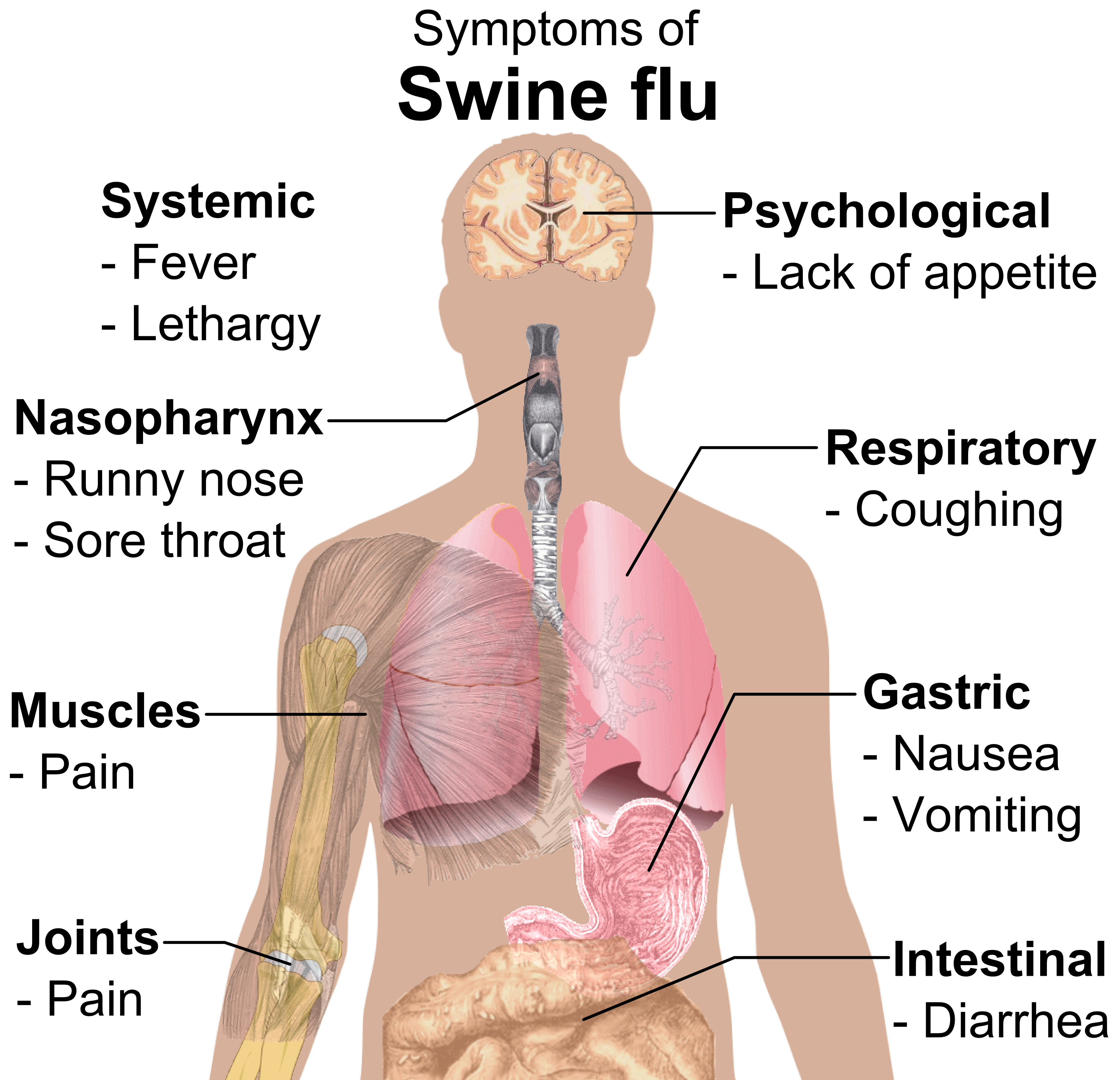
File:Symptoms of swine flu.png - Wikimedia Commons
Swine flu symptoms
Source: Wikimedia commons
After all, over the past 20 years, swine flu, bird flu, SARS, MERS, ebola, zika virus, and other illnesses have come and gone - illnesses which the media warned could become deadly worldwide pandemics. The pandemics that we were warned about just never happened. Zika virus, for example, killed just 53 people. And so I concluded that covid-19, like these other illnesses, would be a minuscule problem which would not impact the lives of people in the developed world in any noticeable way. 

Goodness me, I was wrong. I was so, so wrong. 

Why was I so wrong?

The problem was that I used inducive reasoning:

A pandemic has never happened in my lifetime, therefore a pandemic won't happen now.

It sounds ridiculous when you say it like that, but that really was my reasoning. There have just been so many times - particularly in the last 20 years or so - that the UK media have spotted a new illness spreading in a faraway country and created a moral panic. They said that a deadly pandemic was on its way, and we should be afraid - very afraid. But then virtually nothing happened to us. 

Perhaps when I was a teenager or young adult I was more concerned by these warnings, but as these warnings kept occurring, and with little effect on my life in the leafy suburbs of England, I began to see these pandemic warnings as just more background noise from the media. Bad news is good news in the world of newspapers, and so of course they would leap on any virus and attempt to needlessly whip up the panic among us - it sells papers (or brings in clicks).

Deadly viruses are bad for the communities which suffer them, of course, and I have every sympathy for those who suffer. But so few of them touched the UK in any way that life went on pretty much as normal for us throughout the times of these other viruses, meaning that the UK media were simply scaremongering and sensationalising, as usual.

So by about 2010, any time the media warned about a pandemic, I mentally switched off. They had said that x would cause a pandemic and it didn't; now they were saying that y would cause a pandemic. Based on experience of x being a storm in a teacup, I could be reasonably sure that y wouldn't be a pandemic either.

So when a new coronavirus began spreading around Wuhan in January, and the UK papers warned of a worldwide pandemic, I thought it would be yet another pandemic-cum-damp-squib. I was sure it would fizzle out just as the others did, without any change to life in Little England. The media had 'cried wolf' so many times before with other illnesses that I just didn't believe their pandemic warnings any more.

I was wrong not to believe them. This time the 'wolf' was real, and it was about to huff and puff and blow the world down.

Now here we are, with nearly 30,000 deaths in the UK, and over 200,000 dead worldwide, and the virus is showing no signs of abating. Everything in the UK is shut, including schools, offices, shops, leisure centres, and entertainment venues, and we aren't allowed to meet friends or family. 

The failure of inductive reasoning

Inductive reasoning led me to believe there wouldn't be a pandemic, and even if there was, it wouldn't hit the UK. 

As philosophers, we know that inductive reasoning is weak. All swans are white until you see a black swan. But in life, our experience shapes our way of thinking, and helps us to extrapolate future events based on the past. If Paul has always lied in the past, it'd be silly for me to believe him now. If whenever I lend money to Bryan he doesn't repay me, it would be naive and gullible of me to keep lending him money. So we simply must learn from the past. I think it was George Santayana who said:

Those who cannot learn from the past are doomed to repeat it.

I had learned that when the press warn of a pandemic, it doesn't occur. Now I've learned that sometimes, it does occur.

How bad will covid-19 be?

For the world and the UK, it's going to be horrendous. It already is horrendous, and few if any countries are over the hump yet. On a personal level, I'm just going to keep myself to myself, maintain social distancing, and self-isolate if I have symptoms. I doubt that I'll be in any real danger from the virus if I do catch it. After all...

I've never died before, therefore I won't die now. 

Friday, 6 March 2020

Aphantasia - I never realised I think differently from everyone else

Imagine a beach. Can you see the sand and the waves? I can't.

This week I discovered that I have something known as aphantasia. This is the inability to see things in my imagination - my mind's eye is blind! Of course, I've always known that I didn't really see anything when I imagined it (why would I see it? it's only imaginary after all!), I just never knew that other people really did see what they imagined. I still find it hard to believe that other people see what they imagine.

I was writing something about robot faces as part of my PhD research and I wanted to find out the name for seeing faces in inanimate objects, like doorknobs and car headlights (it's called pareidolia, by the way) and I came upon a page about aphantasia, describing how some people don't see anything when they imagine it. This was not a revelation; it seemed to be pointing out the blatantly obvious. It's like saying that people don't look as beautiful as they wished they looked, or that people aren't as rich as they want to be. Well duh, imaginary things and reality are obviously different. Turns out, it's not so obvious after all, as most people can see what they imagine. Weird.

Baggy McBagface. Image source: The Conversation

It's really strange that I never realised that my thinking was any different to anyone else's, and yet according to several studies, this "condition" of mine affects just 2-3% of people! So I'm in a tiny minority.

So aphantasia is a minority thing; most people have normal phantasia (they see what they imagine), and another minority at the other extreme have hyperphantasia (an exceptionally vivid imagination). I was certainly surprised to discover these differences in how we imagine. I've read Descartes, Locke, Hume, Kant, and other philosophers who wrote about ideas and imagination, and discussed these with others at length. Yet never did I realise that others were imagining differently from me.

Which of these categories do you fall into? To find out, you can take a VVIQ test here. I scored the very lowest score on every single question: no matter how hard I try, I don't 'see' anything when I imagine it. Visualising a beach is as impossible as visualising a colour that doesn't exist; imagining a house is as impossible as imagining what the thirty-second flavour of the alphabet sounds like.

How do I know what I'm imagining?

You might wonder how I know when I'm imagining something. How do I recall what things look like? That's not particularly easy to explain, but I'll try. 

I know when I am imagining something because I'm aware of the thought in my mind. I have thoughts, such as "I'm hungry", and "I must remember to go to the post office" and "I remember putting my purse on the shelf yesterday" and "horses are yay tall" and "5 x 6 is 30". None of these thoughts have any imagery for me, but I now understand that some of them may have imagery for other people. But the imagery really doesn't seem necessary to the thought. I know that 5 x 6 is 30 without having to visualise a rectangle of five squares in six rows: I just remember the fact. It's the same with where I put my purse, or what my mother looks like. I can rattle off a 'shopping list' of features of my mother, just as I can rattle off an actual shopping list. I don't need to see a picture of my mother in my mind to know that she has short hair.

It's both fascinating and unfathomable to discover that other people's imagination really is different from mine. I had no idea. Our minds are private, and I suppose that's why people like me manage to go so long without realising our minds are different to anyone else's. I could quite easily have never found out.

Wittgenstein gave an example that helps illustrate this. He asks us to imagine that everyone has a little box, and inside their box is something which everyone calls a beetle. No one can look in anyone else's box, but each can look in his own box. Everyone says they have a beetle in their box, but I have no way of knowing whether the contents of my box (my 'beetle') are the same as the contents of yours, or indeed if some people have empty boxes. The mind is the same; I cannot leave my own mind and look inside someone else's to check if it's the same as mine.

Probably not what Wittgenstein had in mind, but it's hard to know for sure.

What is life like for me, without any visual imagination?

Well, it seems totally normal to me not to see things I imagine, but that's not helping you to understand what it's like, so I'll try to clarify. But knowing which features of me are features of aphantasia and which are just parts of my personality is tricky. There's no way for me to separate the two, but I'll do my best. But know this: life with aphantasia feels totally normal. I see things that are real, and I don't see things that are imaginary.

Inside my imagination
When I close my eyes and imagine something, all I see is some sort of brownish blotches such as this. I suppose it's the insides of my eyelids that I'm seeing, because when my hands are over my eyes, what I see is darker, and when I'm in bright sunlight, what I see is lighter. But literally whatever I'm imagining or thinking about, this is what I see (if my eyes are closed; if my eyes are open I see what's in front of me).

Some people with aphantasia say they don't have visual dreams. I do. Dreams seem just as real to me as reality does (until I wake up of course). I can recall some dreams and they seem quite vivid. Of course, when I recall them I don't see any images though.

Many people with aphantasia report having a bad memory, particularly for visual things. I would say I have a pretty good memory actually: I can learn the names of a new year group of up to 60 students in a week. I have memorised all the national flags of the world (if I see the flag, I can identify the country; I find it much harder to hear a country's name and describe the flag though), and I obviously have a mind good enough to manage a PhD. I fare very well on all aspects of IQ-type tests, including things that seem to rely on imagination, such as spatial reasoning. I can memorise lists of things, and I can recall things I've heard more easily than many people can. For example, a few years ago I did some conservation work in the Amazon rainforest, and I learned over 70 bird calls. I didn't find it easy, but I did manage it where many others failed.

But my mind isn't perfect; I'll forget appointments if I don't write them down, and I forget how to do things if I don't practice. But I think that's fairly normal. 

I don't really enjoy reading fiction. Especially fiction which is description-heavy such as Lord of the Rings; it's excruciating to have to trawl through lengthy descriptions of a landscape. The fiction that I do occasionally read is more action-based, or I could happily read a play - where there's almost no description at all. I prefer non-fiction, as it sticks to the facts. Although I can read as quickly as anyone else, my comprehension is slower than I'd like. When I used to read fiction, it wasn't uncommon for me to reach the end of the book, but struggle to recall the plot. I have to make notes on academic papers or I will very quickly forget what I've read. That's a bit of a pain, but I've always managed: I am a prolific writer and happy enough to make notes on things I read.

What must life be like for people who do have a visual imagination?

It seems very strange -- and disturbing -- that some people see what they imagine. If you are seeing things that aren't real, that aren't there, then that to me sounds like an hallucination, if not the sign of a serious mental disorder. And suppose a person is imagining their dog is sitting next to them. When they see the dog, how would they know if it's the real dog or the imaginary dog?! It must be a bit like being in a hall of mirrors. Not to mention terrifying. I have sometimes imagined scary or upsetting events - if I actually saw these things happen in front of me because I'd imagined them, I'd be a dribbling wreck, seemingly surrounded by skeletons and snakes and other monstrosities - all imaginary, of course. 

But maybe people don't imagine scary things - perhaps they only imagine nice things. I must admit, it would be nice if I could call the faces of my deceased loved ones to mind, but I can't. I cannot see them any more, and when I imagine (think of) them, I see nothing at all. Dealing with grief must be a whole lot easier when you can just 'see' your loved ones and talk to them simply by imagining it. 

And holidays.... there'd be no need to go and see the Pyramids at Giza, the Grand Canyon, and the Hanging Gardens of Babylon, given that you can just 'see' them for free by imagining them. I'd save a fortune on holidays if I could just see anything I wanted to by an act of will! I'd travel the universe too.

Imaginary pancakes... or are they real? 
I've read that it's not just the sense of sight, but that most people can hear, smell and taste the things they imagine too (there doesn't seem to be the same phenomenon happening for touch though). I don't experience any of these things when I imagine them.

If others really can hear, taste, smell and feel what they imagine, then dieting must be a breeze! You could eat a tiny salad but just imagine that it was a burger and chips, or eat the same dull porridge oats for breakfast every day, but just imagine it was a breakfast fit for a king! I can only assume that it's not as simple as that, but I just can't get my head around the idea of really, actually experiencing the things you imagine.

Just a figure of speech

I'm still sceptical that others really do see (hear etc) what they imagine. Surely, no one can actually see something that's imaginary? You're having me on! It's a collective joke, for sure. Or perhaps - just like with the Emperor's new clothes - no one wants to admit that they can't see something which others claim to see. Most people don't want to feel "abnormal", to have a deficiency in place of an ability which others have.... if indeed others really do have it. So if some people say they can visualise something, others may agree even though they can't in fact visualise it. 

Or like the old me, people may think "visualising" something is just a figure of speech. I speak that way too: I say things like "ooh, I can just imagine myself lying there on the beach under the sun"... well yes, I am thinking about it, and as far as I am concerned, thinking about something and imagining it are the very same things. I always believed that people were speaking figuratively when they said they could 'see' or 'visualise' things. I knew I didn't mean it literally, so assumed they were the same.

Life goes on

It's a curious thing to go one's life (over 40 years now!) having an unusual condition and all the while, thinking it was normal. Anecdotal evidence on forums seems to suggest that people can go almost their entire lives without realising there is anything unusual about their thought processes. It's fascinating to think that a condition such as this, which has presumably been prevalent for quite some time, has hitherto gone unnoticed (or unnamed at least) until the 20th century. It does make you wonder what other mysteries people might be hiding within their minds, all of us trapped in our own little worlds, trying to interact as best we can. 

But in truth, lacking the ability to actually see what is only imaginary does not bother me at all, any more than it bothers me that I can't sense electromagnetic signals the way a shark can, or sniff out a missing person the way a dog can. These are not senses I need nor really want. I am perfectly happy to live with my mind the way it is, and be safe in the knowledge that everything I see, hear, smell, taste, and touch is real. 

Probably.


Tuesday, 8 October 2019

Should vaccinations be compulsory?

Health Secretary Rt Hon Matt Hancock MP recently articulated his support for compulsory vaccinations. He commented that there is a 'very strong argument' for making vaccinations compulsory, and I am wholly with him on this.

Anti-vaxxers

There is a small but significant group of people - anti-vaxxers - who don't believe in vaccinations. This scepticism might take a number of forms. Anti-vaxxers might believe that: 
  1. vaccinations don't really work; 
  2. other methods are better at protecting from illness; 
  3. it's dangerous to inject diseases into people; 
  4. vaccinations carry a significant risk of disease or other condition (such as autism); 
  5. we shouldn't interfere with nature; 
  6. vaccinating a particular child isn't necessary, because the disease in question is uncommon - perhaps because so many other people are already vaccinated.

Some of these standpoints are based in sheer ignorance, while others are based more on hope/faith. Below I examine these claims and argue that vaccination should be compulsory for all who can be vaccinated.


Vaccines don't work

There is a massive body of evidence which shows that vaccines work, and protect against illnesses far better than other methods. Nonetheless, just as abstinence will protect one against sexually transmitted infections better than a condom can, avoiding all human contact is likely to be very effective in the fight against communicable diseases. But in most cases, it's wholly unrealistic, and not a method used by anti-vaxxers anyway.

People might suggest that other methods - such as prayer, homeopathy, voodoo magic and so on - will protect against illnesses as well as or better than vaccines can. I would love to see a clinical peer-reviewed study into this. Group A is vaccinated against measles; Group B prays; Group C uses homeopathy or something similar. Then all participants in each group are exposed to measles in the same way - say, a person with measles coughs in their face. Then, we monitor the results, and see which of the people contract measles. 

Obviously, this sort of study would never pass ethical review - and why not? Because it'd be considered too dangerous for groups B and C! This is of course because we know that the non-vaccinated people would be in critical danger of developing measles, a disease which can kill.

Vaccines cause sepsis, autism etc

Although it's possible to cherry-pick anecdotal stories which show a person who was vaccinated later getting the disease, or to give credence to discredited 'scientific' studies such as the one which linked the MMR vaccine to autism, the overwhelming body of evidence shows that vaccines work, and are not dangerous.

There are some tragic cases where children die suddenly, and it is totally understandable that parents and other relatives or friends would try to find meaning in the death, and to know why it happened. Take sepsis as an example: it arrives with commonplace symptoms such as rapid shallow breathing, low temperature, and nausea, and by the time symptoms seem serious enough to seek medical help, the patient might be beyond the stage where they can be saved. It's only natural to think back to what could have caused it, and what has happened in the few days prior to the illness or death.

If a child has a vaccination, and then a few days later develops sepsis or some other horrible illness, it is understandable that a parent would make a causal link between the two, even if that link is unjustified. But any good statistician knows that correlation doesn't prove causation. Just because a child begins exhibiting symptom Y a few days after event X does not prove that X caused Y. Science doesn't work like that; superstitions do. If a child get sepsis a few days after walking under a ladder this is not compelling evidence of a link either.

So although it's understandable why people would make the link, it's unjustified.

We shouldn't interfere with nature

I have a great sympathy for this sort of attitude, and when it comes to something really invasive like a blood transfusion or an organ transplant, I am even more sympathetic to the standpoint. I can totally understand why some people might prefer to live a more simplistic and natural life, free from medical intervention and 21st century attempts to play god with medical science. It's not a belief I share, but I can understand the motivation to pursue such a life.

Often, but not always, such a standpoint might be grounded in religious beliefs such that one decides that if it is God's will that he dies from measles or heart failure, then so be it, God has decided. To try to circumvent God's plan by using medical interventions is contrary to God's plan and it therefore wrong. I respect that thinking, and when it involves things that only affect oneself, I would never argue that we should force people to have medical procedures they don't want.

HOWEVER

Whilst lifestyle and religious beliefs should be tolerated and respected, when S's religiosity starts to have a potentially fatal effect on everyone else's lives, tolerance and respect needs to come to an end.

If it were someone's religious or personal belief that one should carry razor-sharp weapons in each hand, and swing his hands vigorously as he walked, this is fine on a deserted island, but totally unacceptable in a public place - particularly around children who would be in greater danger from such activities. It would be legitimate to say he cannot enter a public place whilst swinging his knives around.

Analogously, if someone chooses to remain unvaccinated for religious or personal beliefs in the sanctity of nature, this is fine if they are alone or around others who share that belief. But when they bring their potentially disease-ridden bodies into a public place, they are playing Russian roulette with other people's lives - particularly children who are in greater danger from many communicable illnesses. It then becomes legitimate to say he cannot enter a public place whilst he is unvaccinated.

As John Stuart Mill wrote: "The only purpose for which power can be rightfully exercised over any member of a civilised community, against his will, is to prevent harm to others." (On Liberty 1859/1974:68). I may have mentioned elsewhere that Mill is a legal genius, well ahead of his time, and although there are some problems with his theories which future scholars have had to iron out, the principle stands as a really useful one to live by. Do as you please, but when it starts to endanger others, your right to individuality ends. Mill would have supported compulsory vaccination.

Herd immunity

When a high enough proportion of people (typically 95-100% is quoted) are immune to an illness, the remaining 0-5% are safe too - after all, the disease is really uncommon and unlikely to be spread around. If I'm unvaccinated, but all the people I come into contact with are immune to an illness, then I'll never get the illness, because they'll never get the illness.

That's the theory, at least. For some illnesses, this is absolutely true, but I think there might be some illnesses which an immune person can still carry and pass on to others (I'm not totally sure about this though - maybe I'm just remembering that scene in 28 Days Later where the immune children passed on the zombie sickness to their mother?!)

Anyway, even if no one can carry an illness they're immune to, the herd immunity argument only works when the number of people immune to the illness is very high. If only 1% of people are susceptible to measles because everyone else is vaccinated, then there's only a very slim chance of coming into contact with another unvaccinated person - and a slimmer chance still that the unvaccinated person just so happens to be contagious at that moment.

But as the number of unvaccinated people rises, the chance of catching the illness increases. Vaccination against measles among UK children now stands at around 90% - one of the worst uptake rates of any developed country. Herd immunity to measles has been lost.

Some people can't be vaccinated, because they have an autoimmune disease or something similar. And babies aren't vaccinated against every illness the moment they leave the birth canal, but rather, they receive vaccinations in their first few months of life. This means that young babies and some older children and adults are susceptible to preventable illnesses. Why should their health be risked because S decides not to vaccinate their child and instead rely on herd immunity? The herd immunity approach should be reserved for those and only those who cannot be vaccinated for health reasons. Everyone who is able to be vaccinated should be vaccinated.

Smallpox and Measles

Child with smallpox
Does anyone remember smallpox? I don't. No one I know - indeed no one in the entire world - has had smallpox during my lifetime.

In the 20th century, smallpox was responsible for 300-500 million deaths worldwide; in 1950, there were an estimated 50 million cases of smallpox each year. I'm not a mathematician, but that seems like quite a lot. Yet in the last 40 years, there have been 0 cases of smallpox in the world, and it's all thanks to a worldwide vaccination programme. Without the vaccination programme, it would be highly likely that some members of my family and yours would have died from smallpox.

Measles hasn't been eradicated, and is still out there in the world doing its thing. It isn't just getting a bit spotty and feeling under the weather for a few days: it's horrendous, and can be fatal. In 2016, an estimated 90,000 people died of measles worldwide, and plenty of others suffered terribly with the disease, and were left deaf, blind, and with profound physical disabilities or even brain damage.

Wouldn't it be nice if measles went the way of smallpox, and we could eradicate it forever? It could be done through vaccination, if enough people were on board. It certainly seems as though a small but significant group of anti-vaxxers are trying to save measles from extinction, in much the same way that we might save whales and tigers from the brink. They are going out of their way to allow the disease to spread and remain alive, and they take to the streets to campaign, to get others to join their crew.

I would never wish illness or death on anyone, and I hope that anti-vaxxers never have to suffer the heartbreaking situation where their children die from a preventable disease simply because they refused to vaccinate them.... but some of them will die. Moreover, some newborn babies and people with autoimmune disorders who cannot be vaccinated will also die, simply because the anti-vaxxers wouldn't believe the science. It's a tragedy. A preventable tragedy.

Tuesday, 17 September 2019

Is it wrong to pierce a baby's ears?

In many cultures, it is common for parents to pierce the ears of newborn baby girls. This practice is very ethnocentric, meaning that it is commonplace in some cultures, and unheard of nd frowned upon in others. Some people  claim it is harmless, beautiful, and kinder than piercing the ears of an older child- and others claim it is cruel, sexist, and a violation of consent.

If you'd like to read a range of anecdotes and  viewpoints, see this Quora discussion. Below I examine a range of viewpoints and ultinately conclude that although it is a bodily violation and not medically necessary, it may be culturally necessary in some cultures to avoid bullying.

Wrongness

Many things are wrong. It's wrong to accept d a gift without saying thank you without taking a gift, and it's wrong to put millions of people to death because you don't like their skin colour. Both of these are wrong, but they are not equally wrong. Wrongness is a spectrum, and the above two acts are at opposite ends of the spectrum. If baby ear piercing turns out to be wrong, I'll need to say where on the spectrum it lies - just how wrong it is.

Wrongness comes in (at least) two forms: intrinsic wrongness and instrumental wrongness. If something is instrumentally wrong, it is wrong because of its negative consequences. If something is intrinsically wrong, it is wrong in itself, because of the type of act which it is - even if no negative consequences ensue. For example, we might think that dropping litter is instrumentally wrong because it harms the environment and disgusts people. On the other hand, we might think that lying in court is wrong in principle, regardless of the consequences. Of course, some acts may be both intrinsically and instrumentally wrong. Murder is probably wrong in both ways: it is instrumentally qrong because it upsets people, and intrinsically wrong because it's simply wrong to take a life. I'll show below that altbough baby ear piercing is intrinsically wrong (by a very small degree) it may be instrumentally right in some cultures.

Arguments in favour

First, I'll consider arguments in favour of piercing babies' ears. These are:

  1. Babies feel less pain
  2. Babies don't mess with their earrings
  3. It looks cute
  4. Most girls love their earrings
  5. The holes stay open for life
  6. It helps tell girls apart from boys

Babies feel less pain

The first argument in favour of piercing babies' ears is that babies feel less pain, or that they quickly forget about the pain. As for the first claim, here's a little experiment you can do: lay down a newborn baby next to a child, and an adult. Now, get an object such as a pencil case or water bottle, drop it onto each of them, and see who cries. My guess is that the baby would cry, while the others would not. Indeed, if one were to try a more unpleasant (and possibly illegal) experiment of hitting the people, I think the baby would certainly cry, the child may cry, and the adult would not. So the claim that babies don't feel the pain is totally unfounded.

As for the claim that babies don't remember the pain, this is more plausible. If we had hit the newborn, the child, and the adult, it is likely that 5 minutes after the hitting, the child and the adult would both remember that they'd been hit. Would a newborn baby remember it? There's no way to know. She might not behave like she recalls the pain, but that doesn't mean that the pain has indeed been forgotten. 

If it is true that babies forget the pain whereas children and adults do not, then it would seem to be more permissible to hit a baby for fun, than to hit a child or adult for fun. This seems intuitively distasteful. But this doesn't mean it is wrong, of course. There is not a clear way to ascertain whether babies remember the pain.


Babies don't mess with their earrings

It is important to keep newly-pierced ears clean; that much is certain. Adults with newly-pierced ears are good at keeping them clean, but children (aged 2-10) are likely to mess with their earrings with germy hands, possibly causing infections. Very young babies are not able to control their limbs properly, and couldn't fiddle with their earrings even if they wanted to, so their new piercings are likely to stay cleaner than those done on an older child.

But that alone isn't reason enough to pierce their ears. Amputation of the legs is likely to heal better (and be coped with more easily) when performed on a newborn rather than an older child or adult -- but that alone is not reason enough to amputate a baby's legs! We'd need to have some other (positive) reason to pierce a baby's ears or amputate their legs in addition to babies' advanced healing abilities.

It looks cute

I can understand why people think it looks cute, but I myself do not find it cute. It's not commonplace in the UK to pierce babies' ears, and yet we still have babies and children which are very cute. 

Besides, many things might be cute - surgically grafting cat ears onto a baby's head, or tattooing little hearts onto their bodies, but this does not give us adequate reason to do it. Later on, when I discuss consent, we will see that cuteness is insignificant when weighed against body modification.

Most girls love their earrings

This is probably true. Most girls like to look girly, and the chance to wear sparkly earrings like a princess is undoubtedly attractive to many girls.

But not all girls. Some girls don't want to wear earrings, but by the time they are old enough to object to their earrings, they have already had their ears pierced.

But for girls who don't want to wear earrings, they can just take them out, and the scarring is minimal. So ear piercing on a baby isn't like tattooing a baby, where it is significantly more difficult to reverse the procedure if they don't like it.

The holes stay open for life
Oddly, this is often given as a reason in favour of baby ear piercing. People say things such as "I haven't worn earrings in 10 years, but the holes are still there so I can put earrings in if I want to". This contradicts the above argument - that one can just take out the earrings if one doesn't want them. But the fact that the holes stay there for life is surely a reason to say that baby ear piercing is a lifelong infliction - a reason against it. And yet, proponents of babies with earrings use "the holes never heal up" as an argument in favour of ear piercing in newborns. Counterintuitive, huh?

It helps tell girls apart from boys

Among cultures where baby ear piercing is commonplace (such as Spain and other Latino cultures), this argument is frequently put forward, but it is utterly flawed.

First of all, why is it essential for people to know the sex of a baby? They should act the same way towards the baby regardless of its genital configuration or whether it has small pieces of metal in its ears. Perhaps they just want to know which pronouns to use, so they can say "She's gorgeous" or "He's gorgeous" rather than "It's gorgeous". Fair enough, but there are many cultures where baby girls' ears are not routinely pierced - how do they cope with telling baby boys apart from baby girls?

The answer is this: they dress their babies in gendered clothes such as pink flowery dresses or blue dungarees. Or, if one encounters a baby dressed in unisex clothing, one asks "is it a boy or a girl?", and no one takes offence. 

So this argument - the aid to telling boys from girls - is absurd. One doesn't need to tell a baby boy from a baby girl, but even if they do, they can look at the clothes or just ask - piercings are unnecessary for this purpose.

It's tradition 

This is probably one of the weakest arguments in favour of baby ear piercing. There are many abhorrent traditions involving the ritual alteration or mutilation of people's bodies. Some examples include Chinese foot binding, head binding, female genital mutilation, circumcision, tribal tattoos, and the stretching of the neck.

A tradition is only a tradition as long as people keep practicing it. If a tradition is cruel, outdated, unwarranted, or just plain stupid, then there is no need to keep following it. There is a saying: Who is the greater fool: the fool, or the fool who follows him? It suggests that copying stupid actions is even more stupid than the person who did it in the first place. The practice of foot binding (for girls) in China had been a tradition for a long time, but thankfully, people stopped practicing it, and it is now seen as the vile and unnecessary practice it truly is.

So piercing babies' ears solely because it is a tradition is absurd. We would need a better reason than mere tradition for piercing babies' ears.

Arguments against 

Now let's consider some of the arguments against baby ear piercing. These are:
  1. It's dangerous
  2. It's sexist
  3. It's body mutilation
  4. It requires consent

It's dangerous

Earrings can be grabbed and yanked out by the baby themselves, or by other children. They can get caught when removing clothing, or when playing, hugging etc. and when this happens, it hurts. But in the UK, quite a few kids (again, mainly girls) have their ears pierced, and almost all women do. How many people have had an earring ripped out such that their earlobe was actually torn? I would say the number is minuscule. Ear piercing is not dangerous.

It's sexist

Recall the argument above in favour of piercing girls' ears because "it's cute". Why is it only cute for girls and not for boys? The answer, of course, is because we have gendered ideas about what is attractive for boys and girls.

When people pierce a baby's ears, it is always baby girls whose ears are pierced. Very occasionally, one might pierce a single ear of a baby boy, but this is much less common than piercing both ears of a baby girl.

And the reason why it's girls rather than boys who have their ears pierced is undoubtedly because women wear earrings to look beautiful, like princesses and so on. So piercing the ears of a baby girl is a symbolic act which says "I want my daughter to look beautiful". This is highly distasteful, the reinforcement of the idea that girls should look beautiful, with sparkly jewellery, whereas boys should not.

This ethos is unpleasant enough when it circulates among adults, but it becomes more and more grotesque when inflicted on young children and babies. Does a 5 year old need to look beautiful? Of course not, so a new born baby girl certainly does not.

On the other hand, gendered clothes exist for children of all ages, including newborns. If we object to ear piercing among baby girls solely on sexist grounds, we should also object to gendered clothing. It should either be abolished, or it should be acceptable to dress a baby boy in a flowery dress. But many people against ear piercing still think that gendered clothing is acceptable, so sexism alone can't explain the wrongness of ear piercing.

It's body mutilation

Forcing pieces of metal through a child's skin is a form of body mutilation, as is tattooing, circumcision, female genital mutilation, foot binding, and several other (once) common practices. If we object to ear piercing, but not another form of body mutilation, we would have to show that ear piercing is more harmful or less necessary than the one which we accept.

Let's take circumcision, since it is shockingly common. Figures show that over 80% of US males are circumcised, and over 90% of males in Muslim-majority countries. I find this abhorrent and shocking; in the UK, only 4% of males are circumcised, and I can't fathom why anyone would do it to a baby. Given that there is no good medical reason for routine circumcision on babies, I find it sickening and intrinsically wrong that someone would remove part of the genitals of a newborn baby. Of course, people often claim that it's more hygienic (which it isn't), but mostly that it's a tradition - often underpinned by religion. As shown above, tradition alone is no good reason to alter the bodies of babies.

Anyway, since the removal of part of the genitals is far more intimate, invasive, and irreversible than the piercing of the earlobes, it is impossible for anyone to seriously claim that routine circumcision is acceptable but ear piercing is wrong.

Of course, someone might claim that both are wrong, because both are mutilation. This seems true, as they both irreversibly alter the baby's body. However, it is possible to remove earrings, and the remaining ear is very similar to an unpierced ear (there may be a small pinprick still visible). Compare this to circumcision, which irreversibly alters a boy's penis - if a circumcised boy decides he doesn't want to be circumcised, tough, he cannot reverse it, whereas removing earrings will give the person an almost identical ear to an unpierced one. Moreover, when one considers that a man will use his penis for urinating, making love, and masturbating, but a girl will use her earlobes for absolutely nothing, this further shows why ear piercing is far, far less harmful and less invasive than circumcision is.

It requires consent

This is related to the above argument. The suggestion is that body modification is something which morally requires consent, and a child - much less a newborn baby - is unable to consent. Some people even suggest that any touching of the body requires consent. 

This latter claim is reasonable for adults and older children, but is absurd with regards to nonverbal babies and perhaps even all children under 10. Babies and young children need to bathed, dressed, and to have their toileting needs met, but I cannot obtain consent to change my new born baby's nappy - I just change it. The fact that she cannot talk does not seem to be an issue - few if any people claim that I am violating the bodily integrity of my new born by changing her nappy without first obtaining her consent.

Sometimes young children who can speak say they don't want to have a bath or to have their nappy changed, but their wishes should not universally be respected, or they'd be living in filth, which is not in their best interests. Sometimes children's lack of consent should be ignored for their greater good.

This argument works for nappy-changing, but not quite so much for ear piercing, unless we could show that a child's wellbeing would be severely limited as a result of failing to pierce her ears. In somewhere such as the UK, it seems evident that young girls with pierced ears have a childhood indistinct from young girls with unpierced ears. But elsewhere, things may be different.

Recall above that ear piercing is, in Spanish and Latino cultures, used as a shorthand for telling the sexes apart: girls have pierced ears, boys do not. This means that a girl with unpierced ears may be met with confusion or unkind comments, in the same way that a boy who wears dresses may be treated in the UK. This could mean that a girl with unpierced ears could be an easy target for bullies, and this would limit her wellbeing. This alone might be incentive enough to pierce a baby girl's ears.

I said above that traditions are only traditions as long as they keep being practiced, and that is true, but the first few people who break with a tradition may have to be remarkably thick-skinned. Children can be remarkably cruel, and the sphere of gender roles is somewhere that children can bully one another mercilessly. A child who doesn't conform to gender expectations can be an easy target.

A parent might think that baby ear piercing is a silly tradition and that it's unnecessary, but go through with it nonetheless to spare their daughter the burden of being different. If one lives in a Spanish or Latino culture, then failing to pierce a baby girl's ears may be setting her up for a difficult childhood.

Conclusion 

Piercing the ears of a baby girl is invasive and unnecessary. It will be painful to the baby, but she will probably forget about the pain soon after, and the piercings will heal cleanly if the ears are pierced when she is young. It is reasonably non-permanent, and girls who later decide not to wear earrings can remove them and almost no scar is left.

Generally, people should have autonomy over their own bodies, and consent should be obtained prior to invasive procedures or body modification. Ear piercing is a slightly intrusive and momentarily painful procedure, so requires consent (circumcision definitely requires consent). However, we often think it acceptable to give a baby a painful inoculation in spite of the pain or her lack of consent, because we believe it is medically necessary. 

Pierced ears are obviously not medically necessary, and since it is painful and a form of body modification, we can say that it is wrong. It is intrinsically wrong to unnecessarily modify someone's body without their consent, even if no harm ensues. But how wrong is it on the spectrum if wrongness? I believe it is at the end of the spectrum, right next to going to a birthday party without a present. Although I maintain that it is intrinsically wrong to pierce a baby girl's ears, it is only a tiny crumb of wrongness.

It is intrinsically wrong, but, I maintain, it may be instrumentally right, because although it isn't medically necessary, it may be culturally necessary. In the UK it is seen as trashy and oversexualised for a little girl to have pierced ears, so it is certainly not a cultural requirement here. But some places have girls' earrings so ingrained in their culture that having a little girl with unpierced ears is like putting a boy in a pink dress with a bow in his hair. It could be seen as cruel to treat a child in such a way, because it invites confusion and unkind comments from others. So in cultures where it is commonplace for all young girls have pierced ears, it might be best to safeguard girls from bullies by piercing their ears - and probably the best time to pierce them is in the first few months of life, when they heal cleanly.