Showing posts with label law. Show all posts

Monday, 19 April 2021

"Is it Miss or Mrs?": Why my marital status is no one's business but my own

Picture the scene....
A man - say, Mick - walks into a shop and wants to take out a mobile phone contract, or buy a new kitchen, or have some furniture delivered to his house. The shop assistant needs to fill in a form with his details. She gets out the paper form or pulls up the online form on the computer. The first question on the form is "Are you married?"
Pretty weird, right? Why is it relevant in any way whether or not Mick is married? It's not. He wants to buy a mobile phone, or a kitchen, or to have some furniture delivered to his house: it really does not matter whether or not he is married, and we would think it bizarre and unnecessary that he should be asked whether he is married, let alone that it should be the very first question on the form!

So, you'd like your new sofa to be delivered, would you?
Are you married? Image source: Unsplash
And yet this is what happens when women have to give their details for a form. It is almost always the case that the very first question a customer service representative asks is "Is it Miss or Mrs?" Why does the shop assistant need to know whether or not I am married? My marital status makes no difference at all to whether or not I can obtain a service. And yet the form requires that I ascribe myself a title. Why?!

This is not the 19th century, where women are the property of their husband, and it is sinful to live with a partner "over the brush", or strange for a woman my age to be unmarried. Women in 2021 are, I believe, allowed to buy a carpet or suchlike without permission from a man, whether or not I am married. Wow! The rights we girlies enjoy today! Yet I must announce (or 'admit') my marital status when I want to have a carpet delivered to my house, lest the shop delivers a carpet to me on the wrongful understanding that I am a married woman, when in fact I am unmarried. Imagine that! Think of the children!

Given that men and women supposedly have the same rights as one another in the UK today, I don't really see why titles such as Mr, Mrs and Miss are needed at all. When buying a carpet or a kitchen or a mobile phone, "Do you have a vagina?" and "What gender do you identify as?" seem utterly irrelevant questions, but this is essentially what the form is getting at when it asks me to identify my title. Titles are pointless.

Now, if someone has a non-standard title such as Captain, Reverend, Professor or Doctor, then it seems reasonable that they may want to have their title on the form, but for the rest of us, why does it matter whether I am Miss, Mrs, Ms, Mr, or Mx? It does not.

I am looking forward to the day when I don't have to tell the shop assistant whether or not I am married just because I want to buy a carpet; failing that, I will just have to look forward to the day I pass my viva and can call myself 'Doctor' Karen Lancaster. Then I can buy things and have them delivered to my house, and neither the shop nor the delivery driver will know my utterly irrelevant marital status. I hope they can handle the not knowing. Until I obtain my PhD, however, they simply MUST know whether or not I have got married.

We have made many leaps forwards in sexual equality and the recognition of transgender and non-binary people. I hope we continue to make progress. But I think that the clinging to the titles of Mr, Miss and Mrs may be holding us back. If a man does not need to announce his marital status, then why does a woman? If a woman changes her title from Miss to Mrs when she marries, why does a man's title not change from Mr? And if a transgender or non-binary person wants to identify their title as something other than Miss, Mrs or Mr, why can't they? (Mx serves this function, but is often not available on forms.)

I have a dream: I dream of a future where I can put my name into a form without having to declare that I'm an unmarried woman, and silly titles like Mrs and Miss are abolished from the English language altogether.

Thursday, 17 December 2020

Why we shouldn't rush to get back to normal

Life has changed in 2020. That's stating the obvious, of course.

I enjoyed my life in 2019 and previous years a lot more than I've enjoyed 2020, and my heart is aching to get back to freely seeing friends and family like I used to. I'm sick of my own house. Now, with a vaccine being rolled out before Christmas in the UK, it finally seems like life might get back to normal again next year. I, like most people, can't wait for things to get back to the way they were.

But although I loved the old normal much more than I love the new normal, if we think about it rationally, we probably shouldn't rush so much to get back to the old normal. After all, the old normal provided the ideal breeding ground for covid-19, didn't it?

The Perfect Storm

What was it about the old normal that enabled covid-19 to conquer the world? Our exploitative relationship with nature allowed the virus to transmit to humans in the first place, and our relationships with each other allowed the virus to spread. Specifically:

Habitat destruction. It's pretty simple: when we destroy animals' habitats, they either move elsewhere or die. We know they're dying because of the mass extinction that's taking place, but animals are also moving further afield - into human-populated areas. When humans and wild animals live in close proximity, disease can spread from them to us more easily.

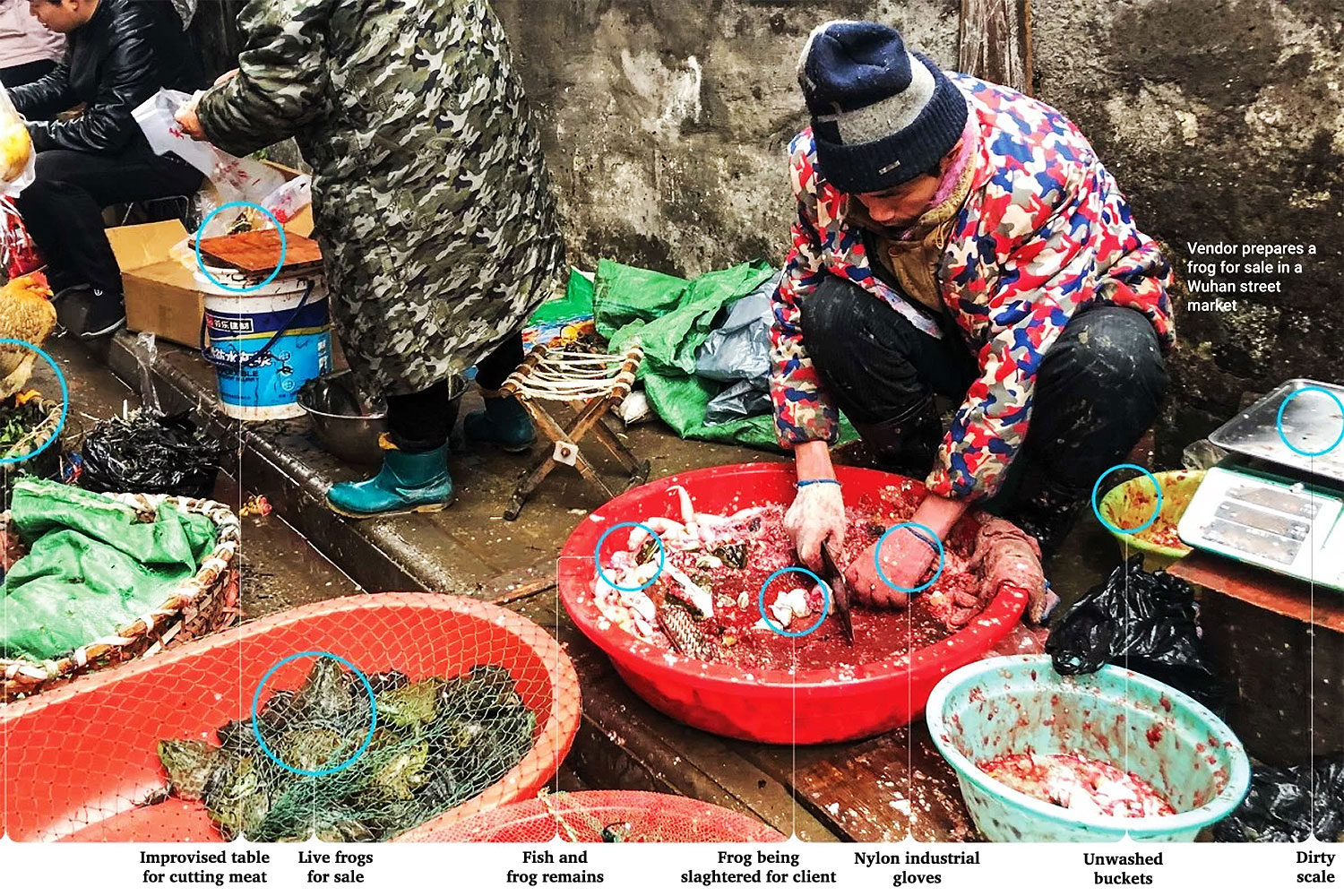
Live animal markets. I can barely begin to explain my disgust at the abhorrent live animal "wet" markets which take place throughout China and some other southeast Asian countries. Aside from the morally indefensible ways in which animals are treated in such places, such markets enable humans to mix with wild, exotic, domestic and farmed animals. This makes them perfect places for viruses to leap from one species to another.
Who would have thought that markets like this would lead to disease?
Image source: Bangkok Post

Densely populated cities. If people had lived in rural communities which kept themselves to themselves, the virus would have fizzled out very quickly. I imagine there are uncontacted Amazonian tribes who are totally unaffected by covid-19; for those of us who live in cities, it's a different story.

International travel. Without air travel, the virus that began in Wuhan would have taken a long time to reach our shores, or may not have reached us at all. But with international travel being what it is, people were freely flying in and out of Wuhan and around the world throughout January, and the virus was here in the UK within just a few days of the outbreak in Wuhan

Shared facilities. Humans live in large communities where we share transport, shops, places of worship, educational establishments, leisure facilities, and food outlets with one another. Shared facilities - especially those with limited cleaning and high footfall - are ideal places for viruses to spread.

Twenty-first century living is great in many, many ways... But humans' way of life has created the perfect storm: covid-19 has spread astonishingly quickly. To put it bluntly, human contact with animals enabled the virus to make the leap to our species, and our interconnected lifestyles in big cities enabled it to spread.

But covid-19 is an anomaly, right?

Well, no. You'd be forgiven for thinking that covid-19 is an anomaly: I myself have pointed out in a previous post that several other lesser pandemics (or almost-pandemics) have come and gone over the last 20 years. 

And apparently, scientists have long been "preparing" for a killer pandemic, ominously calling the hypothetical disease "Disease X". (Wowsers, if 2 million deaths and international omnishambles occur when the world is prepared, then I'd hate to see what might have happened if weren't prepared!) The scientists apparently speculated about Disease X a few years ago. I didn't know this until a few months ago. 

We are lucky that the fatality rate of covid is so low (around 1-2%); by contrast the mortality rate of Ebola and Bubonic Plague (the Black Death) is around 50%. And the worst part of it all is that scientists predict that there will be another, deadlier pandemic within the next decade. I hope they're wrong, but I fear they may be right. If the old normal was a perfect breeding ground for covid-19 --which evidently, it was -- then a return to the old normal will facilitate a new pandemic at some point in our future.

So what should we do?

Clearly, if we are to avoid future pandemics then something needs to change. But I - probably like everyone else - want to have my cake and eat it. I want to have MY old life back, but I want the rest of the world to change so as to prevent future pandemics. I imagine that everyone else feels the same. We all want our old lives back, whether our old lives consisted of going to football matches, university lectures, playing Bridge at a friend's house, or gutting live frogs in a wet market.

I am willing to make concessions such as social distancing or wearing masks in shops, but to have to avoid my family and friends for the rest of my life for fear they might die if I breathe near them,.. well, I don't want to live the rest of my life like that. 

I think the UK is over the hump of the pandemic now (though I'm sure many more deaths will occur - possibly a few million across the world, and it may get worse before it gets better for the people in countries which are slow to vaccinate). 

Image source: Stat News

But what about future pandemics? Well, I never believed that covid-19 would be a pandemic until mid-March and the deaths were skyrocketing, but now I'm (sadly) a convert: I think there will be future pandemics. if it can happen once it can happen again. and next time might have a far higher death rate or it might pick off kids instead of the sick and elderly. There's just no way to know.

Will we learn from covid-19? We might wash our hands a little more frequently, and people may continue to wear masks voluntarily after covid has gone - the way Chinese people have long since worn masks for any and every occasion. And maybe we'll keep our distance from strangers a tiny bit more than we used to. But generally, in the long term, I think we'll be very quick to forget 2020 and keen to jump straight back into our old ways of life, while the next pandemic is quietly brewing away.

Tuesday, 3 November 2020

The US election in Venn diagrams


Today is election day in the US. At times, it seems to dominate the news media more so than the UK election did! I thought it would be fun to do a post about the US election, told through Venn diagrams.

What happened in Texas

In Texas this week, Trump supporters ambushed a campaign bus of Democratic candidate Joe Biden, intimidating them and causing the bus to abandon their campaign events. Trump later took to Twitter to praise his supporters for intimidating the Biden campaign bus.

The central area of the Venn diagram is where such events occur: the intersection of far right leadership, an election, and guns. It's not entirely clear to me whether guns were used in the ambush, but certainly, in a country where gun crime and civil unrest go hand in hand, it is no wonder that the Biden camp were afraid of gun violence. It was in Texas too, a state well-known for its love affair with guns. 

Postal votes and fraud

Trump is concerned that postal votes are fraudulent. This is entirely independent of the fact that postal voters generally tend to favour the Democrat candidate, of course. If postal votes are included in the full count, this lowers the chance of a Trump victory. A strategy then for Trump is to try to undermine confidence in postal votes, and even going so far as to claim they should be ignored. He plans to claim victory before the postal votes are counted.

Studies have found no significant connection between postal voting and fraudulent voting - no more than in-person voting, anyway.

How I'll feel when watching the election results

The election seems to have been in the news for an eternity. Considering that the UK is not the 51st State of the USA, it's interesting to see that the media covers the US election with almost as much interest and passion as it follows our own elections. It's big and important, sure, but I would like it to be over now. But it'll be a while till it's truly over, because it takes quite a while to count all the postal votes. Why they can't employ more vote counters is anyone's guess, but apparently it can take "weeks" to count them.


Why we'll watch it

In spite of the above "is it over yet" mentality, I'm sure many of us in the UK will still check the news at frequent intervals to find out the results as they come in. Why? This Venn diagram shows why.

Any news that is unrelated to covid-19 (or Islamist terrorism in Europe) is like a breath of fresh air. A second big reason is that car crash gawping tendency we have; like watching a horror film through your fingers. I want to watch, but I daren't, for fear of what might happen. 


Public opinion

This last Venn diagram speaks for itself. The world is crossing its fingers.


Disclaimer:

These Venn diagrams are not scientific, and reflect only the sense I get from the news media. The internet is something of an echo chamber, and so it's very possible that the impression I've got from the news outlets I read is not the correct one. 

A final note on democracy

Democracy is great. When people vote, the people should get what they want. I've written elsewhere that the first past the post system is flawed. In the US 2016 election, for example, Hilary Clinton won more votes than Donald Trump, but Trump won the election. That doesn't seem right: I believe that whoever gets the most votes should win the election. Whether or not I like Trump is irrelevant; all that matters is whether the majority of American people vote for him. If they do, then it's right that he becomes President again. 

I've written elsewhere that we should respect politicians because they are, after all, only attempting to represent the views of the people. Trump has some abhorrent views, but if those are the views of the American people, then it's fair for him to win the election, because democracy is more important than getting what you want. This is particularly true for someone such as myself, who is not American; my opinion on US politics really counts for nothing.

EDIT: 4 Nov at 11.20 am GMT. So far, it's 238 electoral votes to Biden, and 215 to Trump. It's not over yet though.

EDIT: 5 Nov at 9.10 am GMT. Biden has 264 electoral votes, Trump has 214. I don't know how Trump's number of votes has gone down since yesterday, but it seems to have done so. So Biden looks almost certain to win. Trump, being a caricature of himself, is throwing his teddies out of the pram and squawking about fraud, and that he'll take it to the Supreme Court. In totally unrelated news, the Supreme Court is choc-full of Trump's buddies. 

Whatever the result of the election, civil unrest seems highly likely in th US in the coming weeks or months. Whether it comes from Trump supporters who believe fraudulent votes have been cast, or from Biden supporters who are angry that democracy isn't being respected, civil unrest seems almost inevitible. Civil unrest in a country where gun crime is already very high. Civil unrest in the country with the world's highest number of coronavirus deaths. Civil unrest in a country where the police and military are horribly heavy-handed. It ain't gonna be good.

EDIT: 6 Nov at 2.20 pm GMT. The result is still uncertain. Still 264 to Biden, 214 to Trump, according to Google. I think Trump is wrong to say that postal votes should be ignored, but he's absolutely right to be exasperated with the amount of time it takes people to count the votes. Jeez! It's simply unbelievable that the country which claims to be the pinnacle of liberty and democracy makes people queue up for 14 hours in order to cast a vote, then takes days or weeks to count the votes. I think kindergarten kids could count faster than this!

EDIT: 7 Nov at 7.35 pm GMT. Hallelujah! There is finally a result to the election! And it "only" took 4 days! What's more, it's the result I for one was hoping for. Biden has won. Not all the votes have been counted yet (wowsers, this counting sure takes a while) but Biden has won more than the magic 270 votes. It's 290, so far. Yay for democracy! Yay for sanity! That said, Trump has secured very close to half of the votes ("the popular vote") - around 48%. Even though I don't like his views, clearly a lot of Americans do, and I think it's only fair that they should have their views represented. Proportional representation is the fairest political system, and it's still fairest even when the person you meant to win is first past the post.

Will Donald Trump accept defeat graciously? If he does, I'll eat my hat.

Saturday, 24 October 2020

Essential shopping and the sorites problem

This week, as part of its "firebreak" lockdown, Wales announced that supermarkets will no longer be allowed to sell non-essential products, and it got me thinking about what "essential" products really are.

Below I'll argue that no products at all -- even food -- are essential if "essential" is to be understood as necessary for the preservation of life. Secondly, I'll suggest that even though many products are not truly necessary, it is reasonable for them to continue to be sold to us in 2020.

The firebreak

First, a bit of background. Wales, like the rest of the UK and indeed much of the world, is suffering rising numbers of deaths from covid-19. First Minister Mark Drakeford announced a couple of weeks ago that Wales would a so-called "firebreak" lockdown. More commonly referred to as a "circuit breaker" lockdown in England, a firebreak is a short (2-4 weeks) but thorough national lockdown aimed at cutting the spread of the virus in order to:

A) save lives

B) decrease the strain on health services 

C) prevent a longer or more extensive lockdown being needed further down the line (a sort of "stitch in time saves nine" approach)

These are noble goals. The idea is that making people stay at home and refrain from mixing with one another should stem the spread of the virus. Under normal (or even "the new normal") circumstances, people often leave the house to buy non-essential products, so if non-essential items are not on sale, then that's a lot fewer people out spreading their germs around. It makes sense to me. But what products are actually "essential"?

Food

To know what products are essential, we need to know what "essential" means. Does it mean essential to having a nice, fun, plentiful life? Or does it mean people would literally start dying without said product? Perhaps it means something in between.

Setting the bar really low

If we define "essential" as "essential to having a nice, fun, plentiful life", then just about every product seems essential. This includes consumer electronics, all clothing, furniture and soft furnishings, toys and games, DIY products, entertainment items, books and stationery, as well as food and drink. Basically any item which is on sale might appeal to someone as a product which can give them a slightly better life, so is essential, and therefore can be on sale during the firebreak lockdown. 

"I just picked up a few essentials." 
Image source: Unsplash

Setting the "essential" bar this low would mean that all retail outlets would remain open, selling everything they always did. I don't think that's what the First Minister had in mind. 


Setting the bar really high

Perhaps the most intuitive definition of "essential" is "people will die without it". Essential does, after all, mean necessary; required; needed. Essential can mean essential to life. But it seems to me that just about all foodstuffs are non-essential.

Will I die if I don't eat my favourite brand of sausage? Nope. Will I die if I don't eat any fruit? Nope. Will I die if I don't eat any X (where X is any individual food or drink item)? Nope. Anyone who has watched the TV show Freaky Eaters will know that people can survive on remarkably limited and seemingly unhealthy diets for years or even decades.

Food is essential, but no individual food is essential. This presents us with a philosophical conundrum. Does this mean the shops should sell all foods, or no food. No one can reasonably argue that supermarkets simply must sell (e.g.) shitake mushrooms, thyme, canned salmon, mint ice cream, and digestive biscuits. We can live without these things. People might see milk, bread, eggs, and fresh fruit and veg as essential, but they are not. We would not die without these products. (The only product which I can see is essential in its own right would be baby formula for unweaned babies who aren't breast fed.)

This presents us with a sort of sorites problem: 

  • If the supermarkets all stopped selling one product, we could easily survive.
  • If the supermarkets all stopped selling two products, we could easily survive.
  • If the supermarkets all stopped selling n products, we could easily survive.
  • ... 
  • Conclusion: If the supermarkets all stopped selling all products, we could easily survive.
The conclusion is obviously false, as with all sorites problems. The nature of a sorites problem is that small incremental changes to the number of items on sale (or grains of sand in a heap, hairs on a man's head) do not make any discernible difference to the conclusion that there is enough food (a heap of sand, the man is bald), but a big change does make a difference. All food isn't essential, but some food is.

There is no magic number at which we can say that the supermarkets are selling the "essential" number of foodstuffs. Moreover, even if we did discover the magic number of essential foodstuffs (say, 36 foods), that still wouldn't tell us which foodstuffs are the essential ones. Even if it were the case that, say, bread is essential, that still would not mean we needed 80 varieties of bread on sale in the supermarket.
Image source: Unsplash


But something tells me that Mark Drakeford wasn't concerned about a sorites problem when he proposed that supermarkets are only sell essential foods. 

In reality, outside of the philosophy classroom, we don't much concern ourselves with sorites problems. [Although I wrote this post about my son presenting me with a sorites problem when I asked him to eat all his peas.] We just tend to pick a point for the sake of pragmatics, and go with it (recent examples include the Rule of Six, and the limit of 15 guests at weddings).

In actuality, Wales' First Minister has deemed that all food products are essential, assuming they are for consumption off site (because cafes, pubs, and restaurants are closed). It's not true to say that they are truly essential, but deeming all food essential certainly helps to avoid unhelpful criticisms about why this food is more essential than that.


Alcohol

Don't even get me started on why the UK government and Welsh Assembly believe that alcohol is a necessary foodstuff. Off licences were one of the few "essential" businesses permitted to stay open during the first UK lockdown back in March. I know Brits are known around the world for drinking 15 pints in one session on a Friday night (and the same again on Saturday night, and maybe a few cheeky pints on Sunday too, plus a few cans after work during the week), but for the government to maintain that alcohol is essential is absurd.

I love a good bottle of red wine, but seriously, nobody needs alcohol. We might like it, love it, or even feel we need it, but we don't. In fact, a firebreak from alcohol might do more for the health of the nation than a firebreak from covid! The sheer horror of having a fortnight of sobriety is clearly too much to handle. Food is essential: booze is not.

Other products 

Even if we accept that food is necessary, just about all other products in our lives are non-essential. Health-type products such as toothpaste, soap, sanitary towels, toilet paper, and laundry detergent might seem pretty important, but are they essential? Would we die without these products? Of course not! Plenty of people around the world manage without these things for their entire lives. It wouldn't be pleasant (for Brits) to have to survive without toilet paper, but bums can be cleaned with water and cloths, as they are elsewhere in the world. 

The Great Toilet Paper Shortage of March 2020
Image source: Unsplash
During the 'Great Toilet Paper Shortage' of March 2020, I refused to panic buy, and was consequently was forced to face up to the prospect that I might have to do without loo roll as my supplies dwindled and I searched for toilet paper in 6 shops across 3 days. I cut up some old tea towels and bed sheets in preparation and desperation. Thankfully, I managed to secure 4 rolls of toilet paper at the eleventh hour from a petrol station, so the cloths were never used for that purpose - but they could have been. My point is that toilet paper is not truly essential; we could have survived without it.

Sanitary towels, too, are not a matter of life and death. Women across the world are forced to live in conditions such that they must use whatever they can during their periods. Cloths, toilet paper, menstrual cups -- all of these are alternatives to sanitary towels and tampons. Few women would want to go without sanitary products, but we could do it if necessary. Edit: It seems that some supermarkets have told shoppers that they can't buy period products! It's hard to know what to make of that. I know I'm saying they're not essential to life and limb, but they're more essential than alcohol, cakes, and many other products which remain on sale in Wales.


Concluding remarks

Image source: Unsplash
Under Wales' rules, the only shops which can stay open are food shops, convenience stores, newsagents, corner shops, bicycle shops, petrol stations, DIY/hardware stores, and off licences. This is a bizarre choice of shops if you ask me. It would seem that the First Minister believes that essential products are food, alcohol, petrol, bikes, and DIY products. Welsh shops have stopped selling stationery, cleaning products, and winter clothing. So I can buy wallpaper but I cannot buy a pen; I can buy 24 cans of Special Brew, but I cannot buy a coat. I can buy bathroom tiles, but not some disinfectant. 

I realise that as with so many things during the pandemic (and probably the rest of the time too) the government are damned if they do, and damned if they don't. Could we survive without almost all products in the supermarket? Of course we could: shops are only a recent development in the history of mankind, and people around the world survive every day without tampons, bikes, alcohol and newspapers. But should we be expected to survive without these products in 2020? Probably not. It's quite reasonable for the Welsh people to demand that winter coats, tampons and disinfectant should be on sale even during the firebreak lockdown.

Edit: several of the news stories above seem to have prompted the supermarkets / the Welsh Assembly into conceding that period products, winter clothing, cleaning products and stationery should remain on sale in supermarkets during the firebreak. 


Sunday, 3 May 2020

Lives versus livelihoods

Picture the scene... you're standing on the edge of a precipice. There's been an accident, and someone is hanging off the edge, barely able to cling on. But they're not the only thing hanging off the edge of the cliff. Nearby, someone's job is also hanging off the edge, barely able to cling on. You can save either the person or the job, but probably not both. It is not guaranteed that you'll be able to save either, but you can give it a go, though it will involve a bit of inconvenience for you to attempt to save either of them. So, which do you choose to save - the person, or the job?

It's a no-brainer, right? If we can ignore for a moment the fact that a job isn't a physical thing that can hang off the edge of a cliff, saving the person's life is still intuitively morally correct.

In case you're unconvinced that lives outrank livelihoods, here's another example.

Picture the scene... a building is on fire. Trapped inside is a person, breathing in the smoke, coughing - they will probably die if no one does anything. Also inside the building is someone's savings, or perhaps their business itself. There probably isn't time to save both the person and the business/savings. You'll have to choose. Saving either of them will be inconvenient for you, but won't place you in mortal danger.

Other things being equal, we would all surely say that human life should be prioritised over money or business. 

And yet, the "lives versus livelihoods" dichotomy which people would be so sure about if we were on the edge of a cliff or beside a burning building is apparently a lot trickier when it comes to covid-19.

A lockdown involving the closure of businesses, shops, and leisure facilities is detrimental for livelihoods, but it saves lives by slowing the spread of the virus. Contrariwise, keeping such places open allows livelihoods to thrive (or at least, to just about stay afloat) at the expense of people's lives - they die because the virus spreads so much. When places such as pubs, restaurants, cinemas and leisure centres are open, money changes hands (+ve for livelihoods and the economy) and viruses change hosts (-ve for lives and the NHS).

The difference, it seems, is whose livelihoods are at stake. Unsurprisingly, those whose livelihoods are most at risk from lockdown (small business owners) are the most vocal in criticising lockdowns. In terms of the analogies above, when S is on the edge of the precipice, and S must choose between saving her own business / savings and saving the life of an elderly stranger, S seems more inclined to save her own livelihood. Also unsurprisingly, those who have most to gain from a lockdown (say, those with elderly parents, or relatives with immune disorders) are the ones most in favour of lockdown. If S is on the cliff and forced to choose between saving his own relative, or the money of a stranger, S saves his relative. 

It seems that agent-neutrality has already fallen off the cliff, and plummeted to its death.

But when we are dispassionate and neutral - when it's a stranger's livelihood versus a stranger's life - I think (I hope!) that most of us would choose to save a person's life. That should give us the inkling that humans generally value lives over livelihoods. And for what it's worth, I think that's the morally correct stance to take.

A few weeks ago, when each covid-19 death in the UK was a news story in its own right, the media always pointed out the age of the victim (they were generally over 60), and whether they had any pre-existing medical conditions (they generally did). It was almost as if these were mitigating factors we could console ourselves with. 
"A woman has become the first coronavirus fatality in the UK"
"Ah yes, but she was in her 70s and had underlying health conditions, so was probably going to die soon anyway."

The subtext is one that suggests that people's lives are worth less (or worthless) if they are a bit old or are in poor health. I think many would agree that we should save the lives of children over the lives of the elderly, but to save jobs and money over the lives of the elderly or vulnerable is something else entirely. People who oppose lockdowns because of the threat to livelihoods are doing so in desperation; nonetheless, they really should re-examine their moral compass.

Another factor is proximity. Singer wrote a great paper (Famine, Affluence and Morality) about how we (wrongly) care more about seeing someone in danger right in front of us, than we do about knowing someone far away from us is in danger. Here's a quote from Singer:

"It makes no moral difference whether the person I can help is a neighbor's child ten yards away from me or a Bengali whose name I shall never know, ten thousand miles away. [...] From the moral point of view, the prevention of the starvation of millions of people outside our society must be considered at least as pressing as the upholding of property norms within our society." (Pp231, 237)

Singer's argument is a little different from mine as he argues that saving a life close to us matters just as much as saving a life far away from us, whereas I'm arguing for the more moderate claim that saving a life (anywhere) matters more than saving money. But if I'm right, the fact that the anti-lockdowners and the lockdown-rulebreakers don't see the deaths they have caused is at least partially what causes them to prioritise their own money over someone else's life.

If a person really was on the edge of a cliff with someone about to die if he does nothing, that situation is a lot more potent than knowing that somebody somewhere will die if he does nothing. I've written previously about people encouraging suicide online - something we don't generally do when a person is right in front of us. The same phenomenon is at play with covid 19 as it is with online suicides, and children starving in faraway countries. Business owners who defy lockdown and people who throw parties in defiance of lockdown are both "benefitting" ftom the fact that they don't see the damage they cause. They don't see the link between their actions today and people's deaths next month. They don't see people keeling over and dying in front of them, or a pile of dead bodies in their front garden. Because of that, it's very easy for them to think only of themselves and their lifestyle or livelihood.

The solution
There are no good solutions to the covid-19 pandemic: there are only bad outcomes. Thousands of people in the UK have died from the virus, and more will certainly die. Livelihoods have been and will be lost during the lockdown. So there are no 'good' solutions. All we can do is try to choose the least worst option.

Just as we would do if we stood on the edge of a cliff, or at the door to a burning building, we should save people's lives first and foremost, then worry about finances later. Money can be lost, and it can be regained. Someone who loses their business can set up another one, or take another job elsewhere. The person who loses their money will get second chances to make money and have a good life. The people who die get no second chance. So in the lockdown versus livelihoods contest, I believe lives should be prioritised.

Friday, 13 December 2019

Election Reflection

It's that time again. No, not Christmas; I do of course mean general election time - which admittedly is about as frequent as Christmas. We've had three general elections and a referendum in the past 5 years. I think I've visited my polling station more often than some of my own relatives' houses.

The results are in from yesterday's election: 365 seats to the Conservatives; 203 to Labour. The election maps are awash with dark blue, for it's the Conservative Party's largest majority since the 1979 when Thatcher won. Whether we think such a landslide is strikingly good or strikingly bad, we cannot deny that it is striking.

Brexit

Given Boris Johnson's continued mantra that he wants to "get Brexit done" - apparently the Conservative Party's top priority - then such a large majority might seem to suggest that the people of Britain* also want to get Brexit done. However, what seems to have escaped Johnson is that 52% of voters backed parties who want a second referendum (Labour, Lib Dems, Greens and SNP) while only 47% of voters supported Brexit-backing parties (Cons and DUP).
* I'll come back to the divisions of Scotland and Northern Ireland below.

Why has there been such a large Conservative majority? Brexit has obviously been a key issue in this election, but I suspect that people (not everyone, but enough to make a difference) haven't necessarily voted for who they think will give them the result they want, but rather, they have voted based upon who is most likely to bring about some closure (of any type - remaining, leaving, anything other than limbo). If I am right, it would not bean enormous surprise, given that the Brexit referendum was 3.5 years ago, and it's barely been out of the news since. People - and indeed the news media - have often said that they're sick of hearing about Brexit.

Could it really be that being bored of Brexit has been one of the major driving forces in the Conservative victory? In "getting Brexit done" Johnson has sought to assure voters that it'll all soon be over. And that, perhaps, is what people want most of all. Just like a friend who keeps talking about their turbulent relationship, even though there are always new tumultuous developments, arguments, arrests, and altercations, it can become tiresome to hear about it day after day. After a while you wish your friend would either commit to making the relationship work, or leave the relationship, but most of all that they'd just shut up about it. And this seems to be many people's attitude towards Brexit at the moment: they're bored of it. I suspect that a sizeable number of people voted Conservative yesterday because they saw the Tories as the party most likely to get it all over and done with. I can't think of any other times in history when voters vote because they're sick of hearing about something, but I suspect this may be the case with this election.

Here's a little quote from Leonardo Dicaprio's character in The Beach  (2000) which seems reminiscent of such an attitude. (Whoever said a movie about backpacking in Thailand cannot give insights into a general election in the UK 19 years later?!)
"In a shark attack, or any other major tragedy, I guess the important thing is to get eaten and die, in which case there's a funeral [...] or get better, in which case everyone can forget about it. Get better or die. It's the hanging around in between that really pisses people off."
Of course, if and when Britain does leave the EU, then that doesn't mean it'll suddenly be out of the news. I would think Brexit will still be newsworthy for a few years yet.

Anyway...

Scotland, Northern Ireland and Wales

Look at a map (rather than a bar chart) of how the UK has voted, and you'll see a marked divide along country lines. 
• England is largely dark blue (Conservative); 
• Wales is dark blue (Conservative) and green (Plaid Cymru); 
• Northern Ireland is dark green (DUP) and burgundy (Sinn Fein);
• Scotland is almost all yellow (SNP)

Map of election results. Source: BBC News

Maps can be a little misleading though - for example, the green (Plaid Cymru) which appears to cover half of Wales does not represent half of Wales's population, but actually only a small share, because the area is sparsely populated. London and other major cities are also deceptive: they're small in area, but in terms of population size and number of constituencies, they're far larger. This means that the cartogram (see diagram below, or here for more info) looks rather different from the map. Labour has done well in urban areas, which are smaller on the map, making the larger rural areas in dark blue look more plentiful than they actually are.

Cartogram of election results. Source: BBC News

As the cartogram shows, the Plaid Cymru seats are very few: Wales has largely voted Labour and Conservative.

But Scotland and Northern Ireland have definitely have not. The success of the SNP has (predictably) added fuel to the fire that is Nicola Sturgeon's burning desire (see what I did there?) for yet another Scottish independence referendum (indyref). Sturgeon is desperate to leave the UK - a position which seems a little inconsistent with her equally desperate desire to remain in the EU. Does she see value in breaking apart from a historic union of countries, or in staying together with old pals? Does she think Scotland needs to join forces with other countries to be stronger? Is she happy to have her power overshadowed by a larger superpower, from further afield? The answers vary depending on which union / power we are taking about: the UK or the EU. 

What is interesting, however, is that despite the startling yellowness of Scotland on the map (and cartogram), Sturgeon's SNP only obtained 45% of the Scottish vote (see here) and so even if all the people who voted SNP are in favour of leaving the UK, this alone would not be enough to win a referendum for it to leave the UK. I expect that Sturgeon will call another indyref, and that Scotland will again choose to remain with the UK and thus out of the EU. But I could be wrong. We'll find out.

I imagine that if EU voters were now asked to decide whether Britain should remain in the EU, they'd vote us out! After all, it's hard to play nicely with someone who says they don't want to be in the gang any more. I wonder whether the people of England (and NI and Wales) would vote to push Scotland out of the UK if they were given the choice? They might. But I don't suppose Sturgeon will ask them.

So the UK may yet see more changes in its makeup. We need not see the dissolution of the UK/EU as a terrible thing though. I've written in a previous post how we need to take Brexit (and the potential loss of Scotland) with a pinch of salt: it;s not the end of the world, but just another page in history. In spite of their lack of support for our two main parties, Northern Ireland looks set to remain as part of the UK. But who knows whether post-Brexit border chaos will change things in Ireland.

Democracy and Proportional Representation

Elections and referendums don't always give us the results we want. I've been eligible to vote for two decades, and during that time, I've seen that sometimes the party I voted for did not win (either locally or nationally). When we lose an election - just as when we lose a board game, or lose our bet on a horse race - we can gracefully accept the result, or we can throw our teddies out of the pram. If we value democracy, then we should accept the result of it, even when we dislike it. Because democracy is more valuable than the rate of inflation, whether the Pound is up against the Dollar, and waiting times in GP surgeries. Freedom to vote means we have freedom to vote in bad leaders with stupid policies, and even if we do vote in bad leaders with stupid policies, then democracy is still worthwhile.

What doesn't seem great, however, is the way in which the number of representatives in the House of Commons is calculated. Here is how I think democracy should work: everyone gets a vote, and whoever gets the most votes is the winner. But our "first-past-the-post" system, doesn't support this, because it is possible for a party to have the most votes, but to still lose the election (massively). See below for how this can happen. Just imagine this happening on a larger scale (I've chosen some neutral colours to represent three main parties in a first past the post system):

                          《--------------Votes ------------》
Constituency       Grey     Beige     Cream
 Const. 1               850        900         750
 Const. 2               850        900         750
 Const. 3               850        900         750
 Const. 4              1300         0          1200
==================================
Total votes          3000      2700       3450
 Seats won              1            3             0

The party with the most votes is the Cream party, with 3450 votes. The Beige party has the fewest votes. But in terms of constituencies won - which translates into seats in the House on Commons - the Beige party has 3 seats, the Grey party has 1, and the Cream party, which received the most votes, has no seats at all.

Democracy is valuable because it gives the people what they want (even if what they want is a silly choice), but a first-past-the-post system doesn't really give the people what they want. The people wanted the Cream party to have the most power, but in fact it has the least power. This seems very wrong.

Let's get back to reality. These results are for the whole of the UK:

                                Con     Lab    SNP   LibD
% of vote won          44        32        4       12
% of seats won         56        31        7        2
No of seats won      365      203      48      11

If we compare the percentage of seats won to the percentage of votes won, we see that the Conservatives have benefited from the first-past-the-post system: they got less than half the votes, but over half the seats. The ones who've really lost out are the Liberal Democrats, getting 12% of the votes, but just 2% of the seats. This seems really unfair for those smaller parties who don't get their views heard.

The above table showed the statistics for the whole of the UK, but let's take a look at Scotland by itself:

                                Con     Lab    SNP   LibD
% of vote won          25       19       45      10
% of seats won        10        2         81       7
No of seats won       6         1        48        4

The results here are even more remarkable: the SNP have benefited enormously from the first-past-the-post system. No wonder they are triumphant about the number of seats they've won: for 45% of the vote to translate into 81% of the seats is shocking. The Lib Dems have lost out a little, but both the Conservatives and Labour have lost out massively in Scotland because of the first-past-the-post system. As I said above, the Conservatives benefited from the system overall, but the fact that anyone is benefiting or losing out because of the first-past-the-post system is unfair. And it's almost always the smaller parties who lose out to the election winners.

If representative democracy is about the views of the people being fairly heard, then proportional representation is essential, or the views of the losing parties are not heard. For the next few years, views represented by Labour and the Lib Dems (as well as other smaller parties like the Greens) will be lost in the blue tidal wave across England, and the Yellow tsunami across Scotland. In the next election, as in previous elections, the winners and the losers may change, but the fact that the smaller parties lose out does not change. Whether the minority parties who fail to win seats have abhorrent views, or progressive views, whether they wish to legalise honour killings or to neutralise the UK's carbon footprint, if they are the views of a significant proportion of the UK people then they should be represented by in Parliament. But they're not. And that is the real tragedy of this election, and indeed every election in the UK.

Tuesday, 8 October 2019

Should vaccinations be compulsory?

Health Secretary Rt Hon Matt Hancock MP recently articulated his support for compulsory vaccinations. He commented that there is a 'very strong argument' for making vaccinations compulsory, and I am wholly with him on this.

Anti-vaxxers

There is a small but significant group of people - anti-vaxxers - who don't believe in vaccinations. This scepticism might take a number of forms. Anti-vaxxers might believe that: 
  1. vaccinations don't really work; 
  2. other methods are better at protecting from illness; 
  3. it's dangerous to inject diseases into people; 
  4. vaccinations carry a significant risk of disease or other condition (such as autism); 
  5. we shouldn't interfere with nature; 
  6. vaccinating a particular child isn't necessary, because the disease in question is uncommon - perhaps because so many other people are already vaccinated.

Some of these standpoints are based in sheer ignorance, while others are based more on hope/faith. Below I examine these claims and argue that vaccination should be compulsory for all who can be vaccinated.


Vaccines don't work

There is a massive body of evidence which shows that vaccines work, and protect against illnesses far better than other methods. Nonetheless, just as abstinence will protect one against sexually transmitted infections better than a condom can, avoiding all human contact is likely to be very effective in the fight against communicable diseases. But in most cases, it's wholly unrealistic, and not a method used by anti-vaxxers anyway.

People might suggest that other methods - such as prayer, homeopathy, voodoo magic and so on - will protect against illnesses as well as or better than vaccines can. I would love to see a clinical peer-reviewed study into this. Group A is vaccinated against measles; Group B prays; Group C uses homeopathy or something similar. Then all participants in each group are exposed to measles in the same way - say, a person with measles coughs in their face. Then, we monitor the results, and see which of the people contract measles. 

Obviously, this sort of study would never pass ethical review - and why not? Because it'd be considered too dangerous for groups B and C! This is of course because we know that the non-vaccinated people would be in critical danger of developing measles, a disease which can kill.

Vaccines cause sepsis, autism etc

Although it's possible to cherry-pick anecdotal stories which show a person who was vaccinated later getting the disease, or to give credence to discredited 'scientific' studies such as the one which linked the MMR vaccine to autism, the overwhelming body of evidence shows that vaccines work, and are not dangerous.

There are some tragic cases where children die suddenly, and it is totally understandable that parents and other relatives or friends would try to find meaning in the death, and to know why it happened. Take sepsis as an example: it arrives with commonplace symptoms such as rapid shallow breathing, low temperature, and nausea, and by the time symptoms seem serious enough to seek medical help, the patient might be beyond the stage where they can be saved. It's only natural to think back to what could have caused it, and what has happened in the few days prior to the illness or death.

If a child has a vaccination, and then a few days later develops sepsis or some other horrible illness, it is understandable that a parent would make a causal link between the two, even if that link is unjustified. But any good statistician knows that correlation doesn't prove causation. Just because a child begins exhibiting symptom Y a few days after event X does not prove that X caused Y. Science doesn't work like that; superstitions do. If a child get sepsis a few days after walking under a ladder this is not compelling evidence of a link either.

So although it's understandable why people would make the link, it's unjustified.

We shouldn't interfere with nature

I have a great sympathy for this sort of attitude, and when it comes to something really invasive like a blood transfusion or an organ transplant, I am even more sympathetic to the standpoint. I can totally understand why some people might prefer to live a more simplistic and natural life, free from medical intervention and 21st century attempts to play god with medical science. It's not a belief I share, but I can understand the motivation to pursue such a life.

Often, but not always, such a standpoint might be grounded in religious beliefs such that one decides that if it is God's will that he dies from measles or heart failure, then so be it, God has decided. To try to circumvent God's plan by using medical interventions is contrary to God's plan and it therefore wrong. I respect that thinking, and when it involves things that only affect oneself, I would never argue that we should force people to have medical procedures they don't want.

HOWEVER

Whilst lifestyle and religious beliefs should be tolerated and respected, when S's religiosity starts to have a potentially fatal effect on everyone else's lives, tolerance and respect needs to come to an end.

If it were someone's religious or personal belief that one should carry razor-sharp weapons in each hand, and swing his hands vigorously as he walked, this is fine on a deserted island, but totally unacceptable in a public place - particularly around children who would be in greater danger from such activities. It would be legitimate to say he cannot enter a public place whilst swinging his knives around.

Analogously, if someone chooses to remain unvaccinated for religious or personal beliefs in the sanctity of nature, this is fine if they are alone or around others who share that belief. But when they bring their potentially disease-ridden bodies into a public place, they are playing Russian roulette with other people's lives - particularly children who are in greater danger from many communicable illnesses. It then becomes legitimate to say he cannot enter a public place whilst he is unvaccinated.

As John Stuart Mill wrote: "The only purpose for which power can be rightfully exercised over any member of a civilised community, against his will, is to prevent harm to others." (On Liberty 1859/1974:68). I may have mentioned elsewhere that Mill is a legal genius, well ahead of his time, and although there are some problems with his theories which future scholars have had to iron out, the principle stands as a really useful one to live by. Do as you please, but when it starts to endanger others, your right to individuality ends. Mill would have supported compulsory vaccination.

Herd immunity

When a high enough proportion of people (typically 95-100% is quoted) are immune to an illness, the remaining 0-5% are safe too - after all, the disease is really uncommon and unlikely to be spread around. If I'm unvaccinated, but all the people I come into contact with are immune to an illness, then I'll never get the illness, because they'll never get the illness.

That's the theory, at least. For some illnesses, this is absolutely true, but I think there might be some illnesses which an immune person can still carry and pass on to others (I'm not totally sure about this though - maybe I'm just remembering that scene in 28 Days Later where the immune children passed on the zombie sickness to their mother?!)

Anyway, even if no one can carry an illness they're immune to, the herd immunity argument only works when the number of people immune to the illness is very high. If only 1% of people are susceptible to measles because everyone else is vaccinated, then there's only a very slim chance of coming into contact with another unvaccinated person - and a slimmer chance still that the unvaccinated person just so happens to be contagious at that moment.

But as the number of unvaccinated people rises, the chance of catching the illness increases. Vaccination against measles among UK children now stands at around 90% - one of the worst uptake rates of any developed country. Herd immunity to measles has been lost.

Some people can't be vaccinated, because they have an autoimmune disease or something similar. And babies aren't vaccinated against every illness the moment they leave the birth canal, but rather, they receive vaccinations in their first few months of life. This means that young babies and some older children and adults are susceptible to preventable illnesses. Why should their health be risked because S decides not to vaccinate their child and instead rely on herd immunity? The herd immunity approach should be reserved for those and only those who cannot be vaccinated for health reasons. Everyone who is able to be vaccinated should be vaccinated.

Smallpox and Measles

Child with smallpox
Does anyone remember smallpox? I don't. No one I know - indeed no one in the entire world - has had smallpox during my lifetime.

In the 20th century, smallpox was responsible for 300-500 million deaths worldwide; in 1950, there were an estimated 50 million cases of smallpox each year. I'm not a mathematician, but that seems like quite a lot. Yet in the last 40 years, there have been 0 cases of smallpox in the world, and it's all thanks to a worldwide vaccination programme. Without the vaccination programme, it would be highly likely that some members of my family and yours would have died from smallpox.

Measles hasn't been eradicated, and is still out there in the world doing its thing. It isn't just getting a bit spotty and feeling under the weather for a few days: it's horrendous, and can be fatal. In 2016, an estimated 90,000 people died of measles worldwide, and plenty of others suffered terribly with the disease, and were left deaf, blind, and with profound physical disabilities or even brain damage.

Wouldn't it be nice if measles went the way of smallpox, and we could eradicate it forever? It could be done through vaccination, if enough people were on board. It certainly seems as though a small but significant group of anti-vaxxers are trying to save measles from extinction, in much the same way that we might save whales and tigers from the brink. They are going out of their way to allow the disease to spread and remain alive, and they take to the streets to campaign, to get others to join their crew.

I would never wish illness or death on anyone, and I hope that anti-vaxxers never have to suffer the heartbreaking situation where their children die from a preventable disease simply because they refused to vaccinate them.... but some of them will die. Moreover, some newborn babies and people with autoimmune disorders who cannot be vaccinated will also die, simply because the anti-vaxxers wouldn't believe the science. It's a tragedy. A preventable tragedy.

Thursday, 25 July 2019

Brexit, Boris, and the future of the UK

As I write this, it's been 3 years since the Brexit referendum, and a week since Boris Johnson became Prime Minister of the UK. It seems a reasonable time to pause and take stock of where we've been, where we're at, and where we're headed -- and how we should feel about it.

In short, as I'll detail below, where we've been is that we've been either unified and disunified at different times; where we are  now is a changeover period, and where we're headed is disunity (until another union!)

How should we feel about Brexit? Well, if you're anti-Brexit, then by all means feel a little bit annoyed or concerned; and if you're pro-Brexit, then by all means feel a little bit pleased. Any more extreme a reaction than that is an overreaction. Things rarely turn out as bad as the popular media and even the "experts" predict.

Impending doom

Remember Y2K? It was predicted that on the stroke of midnight on 1.1.2000 aeroplanes would fall from the sky, mobile phones and computers would stop working, and the world would be hurled into chaos. As it turned out, nothing much happened.

Remember when the UK declared war on Iraq and Afghanistan? The papers warned us that it could be the start of WW3, and an era of terror was upon us, but that didn't happen. Many people have died in the war, and that's terrible - but there is certainly not a world war going on. For most of us, life today is just the same as it was before the war began.

Remember the Labour landslide in the general election of 1997? I was just old enough to vote, and I recall all us youngsters went out wearing red t-shirts and singing Things can only get better, REJOICING that 18 years of Tory rule had finally ended. I felt sure that we were on the cusp of a great revolution... But as the months turned to years, I realised very little had changed.

Remember when Romania, Poland and Bulgaria joined the EU? The papers warned us that we'd suddenly be overrun with migrants from these countries... but that doesn't seem to have happened either.

Remember when they said swine flu / bird flu / MRSA / SARS / Ebola / <insert infectious illness du jour> was going to decimate the UK population in numbers similar to the Great Plague? In reality, more people in the UK died from using hair straighteners than from these illnesses*. So again, the news paranoia spread fear over something which just didn't take hold.
* I made up this claim about hair straighteners, but it's probably close to the truth.

What I'm saying is this: people - whipped up by news media - expect the worst, and reality seldom turns out to be as bad as the pessimistic forecasts would have us believe. Sometimes things do turn out bad, of course, but there are far, far more times when all-out chaos and apocalypse have been predicted, and instead, life has just ticked on as normal.

I realise our country leaving a union with other countries is wildly different from Y2K, the invasion of Iraq, etc. We might think that unity is really important for Britain - but it's worth reminding ourselves that unions have been created and dissolved throughout our history:

  • 6000 BC: The island of Great Britain is cut off from continental Europe by the English channel
  • 43 AD: The island of Great Britain becomes part of the Roman Empire
  • 122 AD: Hadrian's wall built between England and Scotland
  • 410 AD: Britain is no longer part of Roman Empire
  • 927 AD: Various areas (Wessex, Mercia, East Anglia etc) unify to become the Kingdom of England
  • 1284 AD: England conquers Wales and the two are unified into a single kingdom
  • 1603 AD: England and Scotland join in personal union (have the same monarch)
  • 1707: England and Wales form a union with Scotland to become the Kingdom of Great Britain
  • 1800: Great Britain forms a union with Ireland (the whole island) to become the United Kingdom of Great Britain and Ireland
  • 1922: Ireland (minus Northern Ireland) leaves the United Kingdom; the remaining countries become the United Kingdom of Great Britain and Northern Ireland
  • 1952: France, West Germany, Italy, and Benelux (Belgium, Netherlands, Luxembourg) form the EEC, which later becomes the EU
  • 1973: The United Kingdom, as well as Ireland, join the EU
  • 2014: Scotland holds a referendum for Scottish independence (but chose to remain unified within the UK)
  • 2016: The UK decide, via national referendum, to leave the EU
  • 2019: The UK leaves the EU?
  • 202?: Scotland gains independence from the rest of the UK
The above is just a whistle-stop history of England, the UK and the EU. What it doesn't show is all the other unions which have been formed and dissolved elsewhere in the world over the past 1000 years. Even within the last century we've seen the breakup and reunion of Germany, and the unions and subsequent breakups of the USSR, Yugoslavia, and Czechoslovakia. Plus there are many other newly-formed countries all over the world (Western Sahara, South Sudan, Kosovo, East Timor, Serbia, and Montenegro, among others). These new countries haven't arisen because new landmass has been created; they've arisen because an existing country has decided to split into two or more separate nations. The state of political union between countries is not static; it's more volatile than the tectonic plates on which the countries sit.

The pertinent question is whether these unions and breakups have been for the better or for the worse for the countries involved. I don't claim to be an expert in international relations, but from what little I do know, the answer is a resounding ... "it varies".

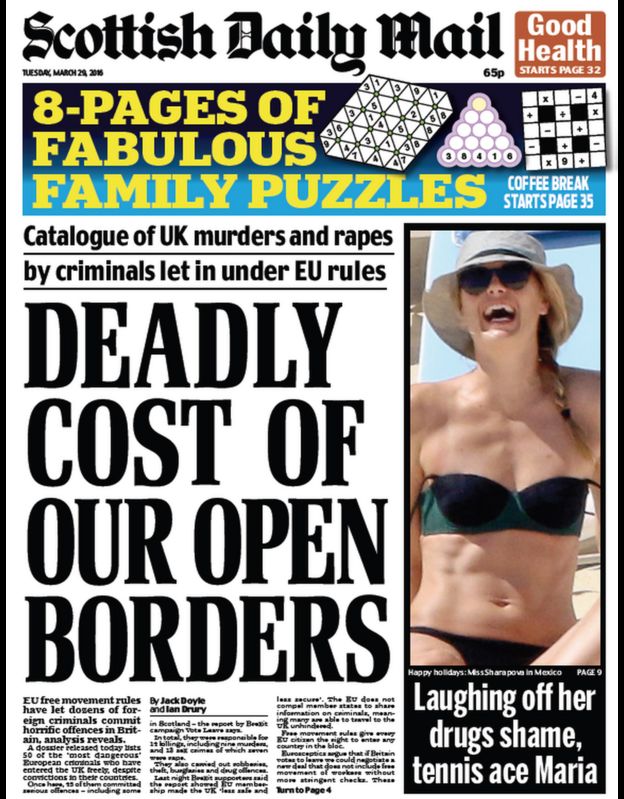
I know this may be hard to stomach, because it doesn't fit neatly with the polarised debates the media like to feed us. Unsurprisingly, we've seen sensationalised headlines on both sides of the debate. On the pro-Brexit side, weve seen headlines such as "The deadly cost of our open borders" (which explains how foreign criminals emigrate to Britain for crime sprees) and "Patients are at risk from EU doctors". On the anti-Brexit side we've seen "May likened to Captain of the Titanic" and headlines describing a "Brexit earthquake" - and if you do a web search for the words 'Brexit' and 'catastrophe' you'll find enough reading material to keep you going for life.

The UK public - by a painfully small majority - voted to leave the EU, and if Boris Johnson's rhetoric is anything to go by, we will be leaving within the next 4 months.

Leaving a union and going it alone does not signal automatic failure and catastrophe for a nation - but nor does it signal automatic success and prosperity. If we look at the examples of other countries who have left unions with other countries, and broken away to form their own country, as I noted above, the prognosis is a resounding "it depends". It's not fully clear what will happen to the UK.

My shocking post-Brexit prediction

Now I will excite and shock you with my prediction about what our lives will be like in the UK post-Brexit:

Things will be a bit difficult for a while, then they'll settle down and go back to normal.

Yes, you read that correctly. I think that the economy, the NHS, education, industry and almost all the other facets of our lives will experience a period of turmoil for a month or two, then dininishing difficulties for 1-3 years, then they'll get back to roughly the way things were before. Maybe not exactly the way they were before - the exchange rate might be 1.49 instead of 1.38, and the organisations might spend their money slightly differently, but essentially, for the vast majority of people, life will feel just the same as it did before.

I understand why people are concerned about Brexit, because the news keeps telling us that it's going to be bad, but I really think that within 1-3 years, things will get back to normal, and then the long term will take care of itself. You might think I'm in denial, but I think I'm taking the news with a pinch of salt.

Who is to blame?

In these uncertain times, the fear and panic which people feel can be slightly mitigated when they have someone to blame. So who should we blame? Maybe the Vote Leave campaign for their false claims about Britain sending £350m a week to the EU? Maybe we should blame the media for taking sides, exacerbating hostility towards migrants and fear of the EU? Or perhaps we should blame the British people for voting on an issue they knew little about? But there's a small group of people - and one person in particular - who seem to have escaped people's wrath, and I say they have a lot to answer for. Who am I talking about?

David Cameron, and the Conservative Party which he led. He was the one who called the referendum. He is the one who started the ball rolling. If you want to blame someone, blame him.

If Brexit is a catastrophic problem, then why on earth hold a referendum in the first place? I've heard it said that the British public voting Leave is like a turkey voting for Christmas dinner. But you know what? Turkeys are pretty dumb, and if given a vote, they might well vote to become Christmas dinner, because they don't understand what they're voting about! So if you really want to preserve the welfare of the turkey, don't give it the vote at all!

If it's true that Brexit spells disaster for the UK, and that it's painfully complex to understand, then leaving such a life-altering decision up to the ignoramuses  on the street is utterly ludicrous. So if you want to blame someone for the way things are, blame David Cameron and the Conservatives. 

It is probably true that the UK public were (and still are) woefully ill-informed about what Brexit will do to the economy, public services etc. Most people make voting decisions on tiny scraps of rhetoric and posturing, in some sort of knee-jerk fashion. Given this (possible) fact, and if Brexit really will be a never-ending nightmare, then why give the British public the chance to vote for it? David Cameron may have the answer, but I do not.

Final word

There are many wonderful times in life, and many terrible ones. The best times of your life are things like your wedding day, playing with your kids, times with loved ones, and parties with friends. The worst times of your life are things like your parents dying, getting Cancer, your child having mental health problems, suffering a disability, being attacked, or getting divorced.

Very few people will have Brexit up there on their list of best or worst things that have happened in their lives. Will you really look back on you life and see Brexit as one of the worst things that has happened to you? If not, then why worry? Get on with your lives, getting married, having kids, partying etc, and enjoy yourself. If, on the other hand, Brexit is really one of the worst moments of your life, then you have my every sympathy.

But I genuinely think that in a few years, Brexit just won't be a concern any more. As Elsa once sang:
"It's funny how some distance makes everything seem small, and the fears that once controlled me can't get to me at all [...] let it go, let it go..."

If ever we need to take the advice of a Disney princess, it's now. Brexit is but a mere tiny blip in our lives, and less still in history.

Wednesday, 29 May 2019

Is it permissible to abuse MPs whose views we oppose?

In the past couple of weeks, Nigel Farage has had a milkshake thrown over himDavid Davies has been called a liar and a traitor, and Chris Bryant has had the word 'traitor' painted across his office in giant red letters. It's also becoming a fairly regular occurrence for female MPs to receive death or rape threats - often from members of the public online but sometimes from other politicians! No doubt this is just the tip of the iceberg; probably countless other politicians have been verbally or physically attacked on the street. It is evident that threats and violence against MPs is at 'unprecedented levels'; some news outlets have suggested that this rise is because of Brexit.

Whatever the cause, it is not just shocking, but shameful, that so many news outlets - even supposedly respectable ones such as the Independent - have branded the Farage-milkshake incident as "funny". Assaulting politicians who are trying to do a day's work is not funny, and it's not OK. Three years ago in June 2016, Labour MP Jo Cox was murdered by a far right lunatic. This was not funny or OK either. If Nigel Farage or David Davies had been seriously injured or killed, would this have been "funny"?

Whether you have left-wing ideals or right-wing ideals, whether you're a Leaver or a Remainer, whether you're online or in person, it is not acceptable to abuse or attack politicians (or anyone).

There may be some extreme circumstances where it is OK - perhaps if the country's leader is a genocidal dictator, and everyone (even his entourage) wants rid of him, and the only way to remove him from power is through violence, then maybe if other possibilities have been exhausted, violence may be permissible (or even right).

But we are light years away from that sort of extreme situation. Nigel Farage is not a genocidal dictator; he is a politician trying to do a day's work to increase support for his party. The same can be said of David Davies, Jess Phillips, the late Jo Cox, and other UK politicians who have been victims of assaults and abuse.

We might disagree with their policies; we might think they will ruin the country; we might think they are liars, dangerous for politics, or even that they are horrible human beings. But that doesn't entitle us to assault or abuse them.

Politicians are just people who are responding to public demand, so if we want to see the real villains who have caused this country's problems, we need only to look around us. We, the British people are the cause of British political problems. If the BNP, UKIP, or the Brexit party are becoming more successful, that is because of the will of the people; the parties and their leader are just fulfilling demand and trying to rise to power by giving people what they want. If no one voted these people in, they would be powerless. The Brexit referendum was promised by David Cameron in 2013 and that promise was at least partly the reason for Cameron's re-election as Prime Minister. It may have thrown our country into temporary turmoil, but democracy involves giving the people what they want, and once the votes have been cast, we should accept the results with some good old British resolve. I don't like the Conservative government, but that's what people voted for and so that's what we've got. Democracy is very valuable, and we can still value democracy while hating it's outcomes.

If we don't like our country's leaders then there are reasonable and unreasonable ways of making our views known:
- voting in elections and referendums = reasonable
- writing to our MPs or other politicians in a firm but non-abusive way = reasonable
- telling politicians face-to-face that their policies are misguided, abhorrent, or problematic = reasonable
- taking to Twitter or other social media to publicly insult and threaten politicians = unreasonable
- throwing food, drinks etc. at politicians in the street = unacceptable
- physically attacking politicians = unacceptable

If we don't like our politicians  (and I can't say I do) then we should criticise their policies and show up their policies for what they are (eg. lies, bigotry, nanny state or whatever) rather than attack individual politicians. Last year I wrote this post about why people should stop criticising Donald Trump's hairstyle, skin colour and saying he has a tiny penis; instead they should criticise his racist policies and mysogynistic attitudes. The same is true of Nigel Farage and indeed all politicians; criticise and attack their policies, not the individuals themselves.

In the heat of the moment, it might seem that a rare opportunity to throw a drink at Nigel Farage is something to make the most of, but I can't help but wonder what might have transpired if his attacker had been holding a knife rather than a milkshake. Would people rejoice in the same way they declared "Ding dong the witch is dead!" when Margaret Thatcher passed away?

Whether someone throws a knife, throws a punch, or throws a milkshake, it is still an assault and it won't stop Farage's devoted following. In fact it might even increase his following - he will probably gain at least some sympathy votes out of it (mine won't be one of them though). At any rate, it won't diminish any following he has, and as The Sun points out, "it'll be him who has the last laugh".

Vigilantes are vigilantes, whether they are left-leaning or right-leaning. We may not like our politicians - we may actively hate them - but that doesn't legitimise abuse and violence. Twitter (and other social media such as Instagram) is a forum for the worst humanity has to offer. People get bolder behind their keyboards and say and do things which they might not normally do in person. I wrote about this just recently in this post, in response to a girl who took her own life after 69% of people in an Instagram poll voted that she should kill herself. As I noted earlier, it is reasonably commonplace for female MPs to receive death threats and rape threats via social media. It's just appalling, whatever the policies leanings or policies of the politician. We must remember that even if someone with horrendous policies is elected, they may be unable to push those policies into law. For example if a politician were elected whosee manifesto supported the introduction of Sharia Law, the reintroduction of slavery, and legalisation of child abuse, these policies would not make it through the House of Commons or Lords, and would quite possibly be prevented by international bodies and organisations. Politicians usually only deliver on their most centrist of pledges.

Whatever we may think about politicians and their policies, we need to behave with a certain amount of decorum; this involves civilised discussion, not violence. But if violence is inflicted upon politicians, I support their right to respond with proportionate violence, the way John Prescott did when he punched a man who threw an egg in his face.